When I try to figure out why I am the way I am, I remember head trauma. Not head-case kinda trauma, I mean literal head injury.
The first that sort of comes to mind is the wiffle ball bat incident. Remember the wiffle ball? It was a tough, plastic, hollow ball with holes perforated all over. You could hit it hard, but it wouldn’t go terribly far—perfect for backyard ball games. The wiffle bat was yellow, long, hard plastic, but skinnier than a traditional baseball bat. And I’m talking rigidly hard plastic. These were no Fisher-Price squishy plastic toys, this was old-school, from way back in the days where weapons masqueraded as toys (remember "jarts”?).
I must have been between 10 or 12 years old, and, somehow, my brother persuaded me that if I stood really still, he would hit a wiffle ball from off the top of my head. My memory of this whole incident is shaky, so I recall only what I groggily recorded. My brother pulled back hard, grimacing, not like an “I’m gonna give the ball a little tap” kinda look, more, “I’m knockin this thing to the smithereens.” And I got scared. Rightly so. This kid was aiming a hard plastic bat at my head. And as I also foggily recall, there may have been a yo-yo to the head incident in the recent past as well to spook me.
I guess I didn’t do the smart thing and duck. I guess I did something stupid, like jump up on my feet, because the next thing I knew I couldn’t see straight and I was stumbling around. I don’t even remember the pain I was hit so hard. I remember holding my head and temporary vision loss, and staggering drunkenly. I couldn’t speak. I remember my brother tenderly putting his arms near me and saying, “Are you all right?” and I couldn’t answer.
Then I remember the hallmark of any family injury: “Don’t tell Mom, OK? Please don’t tell mom!”
But I still don’t remember being able to speak. I remember holding my poor, precious head, my vision swimming back to normal, and standing in stunned silence. My little sister stopped doing whatever pretend gymnastics she was doing, and just stared at me. And then HE got mad at ME. “It wouldn’t have happened if you hadn’t moved! It was your fault!” And so on, displacing blame.
I don’t remember anything after that about what we told mom or if I was given an ice pack. I don’t remember if I cried or just sat in the grass, unable to speak. This entry would have more dramatic purpose if I could manufacture what came next, but this isn’t fiction, and all I remember is speechlessness.
What I do remember is that I always went in for these stunts. Any time the opportunity arose to knock something off my head or throw something hard really near my head, I went for it. I’m the sucker. I’d have done anything for those few precious moments of my brother’s undivided attention.
Wednesday, February 28, 2007


Crickets again
I've been working on this in my spare time, and it rules. But it's taking my creative brain power a little away from the blog. Just temporary like, so don't be hurt or sad, I won't be away long.
I'm also going to see the fam in Kentucky for a long weekend. That usually brings up some good blog juice.
Hugs babies,
Christine Wy
I'm also going to see the fam in Kentucky for a long weekend. That usually brings up some good blog juice.
Hugs babies,
Christine Wy
Monday, February 26, 2007
Us tortured souls
I feared fiction writing as an undergrad—even as a high school student. Those kids had it so together, smoking Clove cigarettes or Camels, waving their hands against the tapestry of their rumpled clothes. They were assured, positive that they were brilliant and alive, and, me, I felt intimidation and insecurity, and held them to me like Linus’ blue blanket.
Graduate school was worse. I went to a good school, a good English program, but I fell through the cracks. I watched all my sparkly peers get endorsements and encouragement and thesis help from the top professors. I watched them laugh together over literary theory. I watched the back claps and the promises of letters of recommendation and career advice.
When I asked for a letter of recommendation, I was asked, “Who are you again? Can you resubmit the papers you wrote for my class with my comments on them?” No career advice. No back claps. I just never fit into that program for some reason.
And I rebelled against it. I dyed my hair pink, I pierced my nose and my lip, “You won’t let me in your secret society? I’ll give you a reason not to let me in your secret society.”
Amazingly, at the very end of my very last semester there, the leader of the cool clique said to me, “You’re obviously intelligent, what did you think of last night’s reading?” And I was in. For two whole weeks, I was in the in crowd, because he said so, he acknowledged me. I hated him more than when I hated him from keeping me out. And besides, he was just pumping me for information because he didn’t do the homework.
The English Department elitism kept me out of fiction for fear that my insecurities would be discovered. I’d never wave my cigarette right; I’d never have the intentionally careless wardrobe or the signature all black clothing. I liked flowers and nature and Walt Whitman, not bridges to nowhere and Camus (who they never understood anyway).
Now I’m making up for it. Now that I understand they were never that casually brilliant themselves, that I was never as inadequate as I feared, I’m making up for lost time.
I meant this blog post to be an outline of my self-taught fiction process, but it’s become my own manifesto. I get Camus. I get Whitman. I get broken bridges and flowering trees. I didn’t need the in crowd to teach me what I already know, I only needed the courage to see what I have inside.
Graduate school was worse. I went to a good school, a good English program, but I fell through the cracks. I watched all my sparkly peers get endorsements and encouragement and thesis help from the top professors. I watched them laugh together over literary theory. I watched the back claps and the promises of letters of recommendation and career advice.
When I asked for a letter of recommendation, I was asked, “Who are you again? Can you resubmit the papers you wrote for my class with my comments on them?” No career advice. No back claps. I just never fit into that program for some reason.
And I rebelled against it. I dyed my hair pink, I pierced my nose and my lip, “You won’t let me in your secret society? I’ll give you a reason not to let me in your secret society.”
Amazingly, at the very end of my very last semester there, the leader of the cool clique said to me, “You’re obviously intelligent, what did you think of last night’s reading?” And I was in. For two whole weeks, I was in the in crowd, because he said so, he acknowledged me. I hated him more than when I hated him from keeping me out. And besides, he was just pumping me for information because he didn’t do the homework.
The English Department elitism kept me out of fiction for fear that my insecurities would be discovered. I’d never wave my cigarette right; I’d never have the intentionally careless wardrobe or the signature all black clothing. I liked flowers and nature and Walt Whitman, not bridges to nowhere and Camus (who they never understood anyway).
Now I’m making up for it. Now that I understand they were never that casually brilliant themselves, that I was never as inadequate as I feared, I’m making up for lost time.
I meant this blog post to be an outline of my self-taught fiction process, but it’s become my own manifesto. I get Camus. I get Whitman. I get broken bridges and flowering trees. I didn’t need the in crowd to teach me what I already know, I only needed the courage to see what I have inside.
Sunday, February 25, 2007
Making Up
It was pretty passive-aggressive* of me to post about how mad I was at Matthew in the middle of the night while he was sleeping, but I had to get it off my chest, cause it just hurt like a weight. Getting made up to was perfect though. He went out last night and scraped the snow off my car so I wouldn't have to do it this morning. That's love, scraping snow and ice in the middle of the night.
*A disorder no longer recognized by the DSM.
*A disorder no longer recognized by the DSM.
Saturday, February 24, 2007
Crisis of conscience
We just left home karaoke at our friend’s house in Blue Island. I was driving, we were tired, and I wanted a little reassurance.
“How’d I do tonight?” I asked.
Matthew was quiet for a bit.
“Honey, we both suck but we have fun.”
I felt my heart sink and my throat get a little woozy. “Suck” was news to me.
Anyone who’s heard me sing a cappella will indeed tell you I’m terrible. I need a band, I need back-up, I need tonal supervision, and I project best into a microphone. I was always in church choir and lauded for my voice, and, every time I’ve sung karaoke, I’ve been congratulated on my singing. Real congratulations, not sympathy congrats like you give to your losing opponents in little league, not just, “good job,” and a fake grip-n-grin. People have looked for me when I’ve sung karaoke in bars and said, “You did great with the Go-Go’s.” Who would lie about that?
But I’ve just been told, “Honey, we both suck but we have fun.”
I asked him, “No one’s ever told me I’m bad at karaoke. Are you really saying I’m bad at karaoke?”
“We had fun, and that’s what matters.”
No, that isn’t all that matters. A lifetime of compliments on my stage performance has just been questioned for the first time ever.
“Matthew, everyone’s told me I sing well at karaoke.”
“Well, who are you going to believe? Them or me?” he asked, half-asleep already.
“Your opinion is the one that matters most to me,” hoping for the affirmation, hoping he’d change his mind or at least fake it a little.
Silence.
My evening of fun, competent, group singing felt undone. I questioned every note I’d sung. Was it when I couldn’t get the low notes in “Rio” by Duran Duran? Was it because I didn’t know all the words to “Mirror in the bathroom”? Did I sing the girl parts too loud on “Love Shack”?
What about the last time I sang karaoke? Was it my rendition of Melanie’s “Roller skates”? She sang it funny herself, she warbled and squealed, so I warbled and squealed. Was that bad?
All I really wanted to be told was that I performed adequately. I know I’m not Melanie. I know I’m not Belinda Carlisle. I definitely know I’m not Simon Le Bon. I just wanted to know that I didn’t suck, that I had a good time and didn’t suck.
At least I had the best microphone.
“How’d I do tonight?” I asked.
Matthew was quiet for a bit.
“Honey, we both suck but we have fun.”
I felt my heart sink and my throat get a little woozy. “Suck” was news to me.
Anyone who’s heard me sing a cappella will indeed tell you I’m terrible. I need a band, I need back-up, I need tonal supervision, and I project best into a microphone. I was always in church choir and lauded for my voice, and, every time I’ve sung karaoke, I’ve been congratulated on my singing. Real congratulations, not sympathy congrats like you give to your losing opponents in little league, not just, “good job,” and a fake grip-n-grin. People have looked for me when I’ve sung karaoke in bars and said, “You did great with the Go-Go’s.” Who would lie about that?
But I’ve just been told, “Honey, we both suck but we have fun.”
I asked him, “No one’s ever told me I’m bad at karaoke. Are you really saying I’m bad at karaoke?”
“We had fun, and that’s what matters.”
No, that isn’t all that matters. A lifetime of compliments on my stage performance has just been questioned for the first time ever.
“Matthew, everyone’s told me I sing well at karaoke.”
“Well, who are you going to believe? Them or me?” he asked, half-asleep already.
“Your opinion is the one that matters most to me,” hoping for the affirmation, hoping he’d change his mind or at least fake it a little.
Silence.
My evening of fun, competent, group singing felt undone. I questioned every note I’d sung. Was it when I couldn’t get the low notes in “Rio” by Duran Duran? Was it because I didn’t know all the words to “Mirror in the bathroom”? Did I sing the girl parts too loud on “Love Shack”?
What about the last time I sang karaoke? Was it my rendition of Melanie’s “Roller skates”? She sang it funny herself, she warbled and squealed, so I warbled and squealed. Was that bad?
All I really wanted to be told was that I performed adequately. I know I’m not Melanie. I know I’m not Belinda Carlisle. I definitely know I’m not Simon Le Bon. I just wanted to know that I didn’t suck, that I had a good time and didn’t suck.
At least I had the best microphone.
Friday, February 23, 2007
Feeling a little left out
Family Wy discovered some new issues to work on in group therapy. Abandonment. We’re having abandonment issues.
Matthew, Dr. Wy, was away for a week on business. While this was all fine and dandy for Blanche DuBois at first, since I let her eat food off the floor and let her smell things on walks longer than her father allows her, Blanche had a turning point where she just missed her Daddy.
All sudden-like, Miss Blanche just would not go into her crate.
For two years, when asked to go to her crate, Blanche DuBois would walk into her crate, sit down, and watch you lock the door. No problem. Sometimes she was rewarded with a treat, sometimes she got only a “Good girl!” but she always went into the crate.
Dr. Wy, you see, works from home many days of the week. His unconventional schedule means that Blanche has lots of time to just lay on the couch or loll dutifully at his feet while he grades papers. But during the Dr’s absence, Miss Blanche had to abide by my draconian schedule, wherein I work from nine-to-five daily, and thereby Miss Blanche is locked in the crate during the day.
By the end of Matthew’s business trip, Blanche just would not go into the crate. I guess she missed her time with her Daddy that much and was tired of being locked away. She would go to the other room and lay limp in a dead weight pose and just sulk. There was no getting her into the crate unless extra-large, extra-chewy, extra-special treats were used as an enticement.
This went on through the first night of Dr. Wy’s return. Dear husband came home, and we were ready to go out for a “welcome home” dinner, and Blanche just would not go into the crate.
I told Matthew, “She’s been doing this all week.”
She went all limp and squishy, and Matthew went Alpha Male on her.
“Blanche! Crate!” He growled, pointing where she was to go.
Instead she crawled, belly on the ground, to the kitchen, and cowered on the floor.
Matthew marched to the kitchen, “Blanche! Crate!”
She wriggled a few feet closer to the crate, but would not go.
As a last resort, she was bodily lifted and placed into the crate.
Locking our apartment door behind us and stepping away, we heard the unmistakable, glass-rattling baritone of a betrayed, full-blooded basset hound howling, full tilt, for all the world to know her angst.
Separation anxiety. Matthew was gone so long, our sweet floppy basset developed separation anxiety.
And now we know we can never divorce because the dog would go nuts.
Matthew, Dr. Wy, was away for a week on business. While this was all fine and dandy for Blanche DuBois at first, since I let her eat food off the floor and let her smell things on walks longer than her father allows her, Blanche had a turning point where she just missed her Daddy.
All sudden-like, Miss Blanche just would not go into her crate.
For two years, when asked to go to her crate, Blanche DuBois would walk into her crate, sit down, and watch you lock the door. No problem. Sometimes she was rewarded with a treat, sometimes she got only a “Good girl!” but she always went into the crate.
Dr. Wy, you see, works from home many days of the week. His unconventional schedule means that Blanche has lots of time to just lay on the couch or loll dutifully at his feet while he grades papers. But during the Dr’s absence, Miss Blanche had to abide by my draconian schedule, wherein I work from nine-to-five daily, and thereby Miss Blanche is locked in the crate during the day.
By the end of Matthew’s business trip, Blanche just would not go into the crate. I guess she missed her time with her Daddy that much and was tired of being locked away. She would go to the other room and lay limp in a dead weight pose and just sulk. There was no getting her into the crate unless extra-large, extra-chewy, extra-special treats were used as an enticement.
This went on through the first night of Dr. Wy’s return. Dear husband came home, and we were ready to go out for a “welcome home” dinner, and Blanche just would not go into the crate.
I told Matthew, “She’s been doing this all week.”
She went all limp and squishy, and Matthew went Alpha Male on her.
“Blanche! Crate!” He growled, pointing where she was to go.
Instead she crawled, belly on the ground, to the kitchen, and cowered on the floor.
Matthew marched to the kitchen, “Blanche! Crate!”
She wriggled a few feet closer to the crate, but would not go.
As a last resort, she was bodily lifted and placed into the crate.
Locking our apartment door behind us and stepping away, we heard the unmistakable, glass-rattling baritone of a betrayed, full-blooded basset hound howling, full tilt, for all the world to know her angst.
Separation anxiety. Matthew was gone so long, our sweet floppy basset developed separation anxiety.
And now we know we can never divorce because the dog would go nuts.
Thursday, February 22, 2007
Take out the papers and the trash
Coincidentally, the most famous blogger on the planet earth and I made the same New Year's resolution, our only resolution: to throw away more things. I guess she could have resolved something private that she didn't blog about, like to pick her nose less, but I don't know for sure. What I know for sure is that I resolved to throw more things away.
That's it. New Year's Eve, lying in bed, listening to my neighbors shout about how drunk and horny they are into my bedroom window from their exclusive roof deck, I decided, "I will throw away more things this year."
I'm a hoarder. Technically I haven't crossed the line into the clinical sense of hoarding, but it's a fine line for me and I try to test it with my big toe sometimes. Example: for a long time, like feud-length time, Matthew and I had this fight over the garbage can.
"Why do you always leave garbage on the counter next to the sink?"
"I don't know!" (I get really defensive over nothing in these confrontations and always end up shouting.)
"We have a small kitchen; the garbage can is five feet away."
"So! I don't want to walk over there!"
"It's five feet," he explained calmly. "Just try, OK?"
"All right, I'll work on it."
Weeks later:
"Why do you always leave garbage on the stove?"
"I might need to use it later!"
"For what?"
"I could use that half-used paper towel to wipe up something else!"
"But what about this milk ring? You aren't using that for anything else."
Me, shouting more, "But it's almost to the garbage can! See, I've gotten better! It's closer to the garbage can!"
"But the garbage can is right next to the stove. It's one more foot. You're already at the stove, why can't you reach into the garbage can?"
"But I'm better than when I left it at the counter!!!"
After months of garbage can negotiations, I can conscientiously look at a piece of garbage and say to myself, "That goes in the garbage can," and I'll actually do it. I'll actually place garbage in the can. This is huge for me, considering I let my junk mail pile up all over the living room and then go through it all at once every other month (that's being generous, it isn't that often), and finally throw it all away. When I clean up, I end up with six bags of garbage, instead of filling them gradually like someone who doesn't hoard would do.
My first step toward realizing my New Year's resolution was to clean out my backpack. As a librarian, I'm always photocopying random bits that I think are interesting then shove them in my backpack. There they ferment into vertically squished pulpy mishmashes that have no educational purpose any longer and, specifically, no reference to my life any longer.
So here it is, the result of the backpack purge:
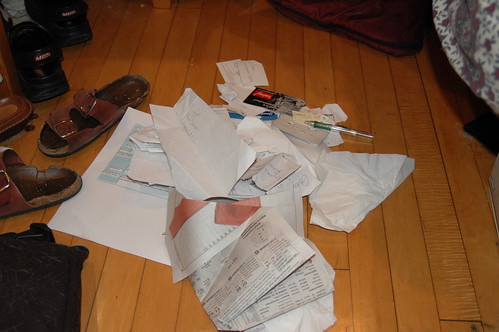
The "purple" faux Birkenstocks, no matter how nasty they look, are not actually part of the purge. I'll die with those nasty things stuck to my feet. Literally. They stick to my feet and they have no grip left. I could fall and break my head on garbage at any moment.
And, for the cutie-pie version of the clean-up, here's my beloved basset Blanche helping with the fun:
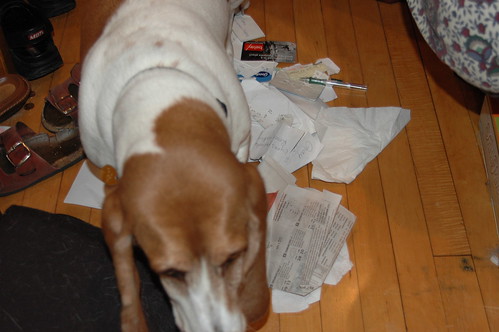
Aww.
Ever onward. Now I'm going to go throw away some food.
That's it. New Year's Eve, lying in bed, listening to my neighbors shout about how drunk and horny they are into my bedroom window from their exclusive roof deck, I decided, "I will throw away more things this year."
I'm a hoarder. Technically I haven't crossed the line into the clinical sense of hoarding, but it's a fine line for me and I try to test it with my big toe sometimes. Example: for a long time, like feud-length time, Matthew and I had this fight over the garbage can.
"Why do you always leave garbage on the counter next to the sink?"
"I don't know!" (I get really defensive over nothing in these confrontations and always end up shouting.)
"We have a small kitchen; the garbage can is five feet away."
"So! I don't want to walk over there!"
"It's five feet," he explained calmly. "Just try, OK?"
"All right, I'll work on it."
Weeks later:
"Why do you always leave garbage on the stove?"
"I might need to use it later!"
"For what?"
"I could use that half-used paper towel to wipe up something else!"
"But what about this milk ring? You aren't using that for anything else."
Me, shouting more, "But it's almost to the garbage can! See, I've gotten better! It's closer to the garbage can!"
"But the garbage can is right next to the stove. It's one more foot. You're already at the stove, why can't you reach into the garbage can?"
"But I'm better than when I left it at the counter!!!"
After months of garbage can negotiations, I can conscientiously look at a piece of garbage and say to myself, "That goes in the garbage can," and I'll actually do it. I'll actually place garbage in the can. This is huge for me, considering I let my junk mail pile up all over the living room and then go through it all at once every other month (that's being generous, it isn't that often), and finally throw it all away. When I clean up, I end up with six bags of garbage, instead of filling them gradually like someone who doesn't hoard would do.
My first step toward realizing my New Year's resolution was to clean out my backpack. As a librarian, I'm always photocopying random bits that I think are interesting then shove them in my backpack. There they ferment into vertically squished pulpy mishmashes that have no educational purpose any longer and, specifically, no reference to my life any longer.
So here it is, the result of the backpack purge:
The "purple" faux Birkenstocks, no matter how nasty they look, are not actually part of the purge. I'll die with those nasty things stuck to my feet. Literally. They stick to my feet and they have no grip left. I could fall and break my head on garbage at any moment.
And, for the cutie-pie version of the clean-up, here's my beloved basset Blanche helping with the fun:
Aww.
Ever onward. Now I'm going to go throw away some food.
Wednesday, February 21, 2007
A foreigner everywhere
“Ever since then I have believed that God is not only a gentleman and a sport, he is a Kentuckian too.” The Sound and the Fury
Only a Kentuckian—or someone who understands Kentuckians deeply—understands Faulkner’s quote. I saw the quote misused by a Kentucky militiaman, though, so maybe that de-bunks the theory, but, really, it takes some knowing Kentucky to get your mind around that one.
When misused, the militiaman from Fort Knox meant that it is an upstanding and prideful thing to be a Kentuckian, which it is, but that’s not all there is to it.
Kentuckians are contrary. We want to be called Hillbillies when it’s convenient, and, by God, we’ll load our double-ought shot gun and level it at your head if you call us one when the time ain’t right.
If God were a Kentuckian, he’d play both sides of the Civil War (which we did). If God were a Kentuckian, he’d hate his brethren and outsiders with the same vehemence, while embracing them tightly and offering them sweet tea and time to sit down a spell (which we do). If God were a Kentuckian, he’d be suspicious and wary of even his favorite neighbor, but he’d trust his governor to lead him to salvation directly without once questioning the plague of nepotism or patronage.
I do not intend to insult God or Kentuckians, but do you see the pattern here? Kentuckians are contrary deep in their blood. They’re cool and breezy and casual, but deadly serious about horse racing and corvettes, race relations and patriarchal lineage.
I’m from Louisville, Kentucky, an island of society that belongs nowhere. Louisville won’t have a thing to do with the rest of the state because “we’re not like those hillbillies.” And the rest of Kentucky won’t have a thing to do with Louisville because “they’re not like us hillbillies.” And the rest of the country regards Louisville squarely as part of Kentucky, which it isn’t, and so it belongs nowhere. Sovereign to nothing.
Louisvillians resent everyone but other Louisvillians because they can’t trust that an outsider will understand how precious it is to be a Louisvillian by birth. Louisville is the cultured, tasteful, polite and sophisticated spot in the morass of Hatfields and McCoys and Muhlenberg Counties. Someone from Ohio once said to me, smiling broadly, “Ah, Louisville, the gem of Kentucky.” No one had ever surmised my hometown so succinctly in my life. A gem, yes, but still, a gem of Kentucky soil, tainted both by its heart’s wish to be perceived as untainted and its desire to belong to the rest of state—when it wants to.
Outside Kentucky, distinctions of Louisvillian or Kentuckian are meaningless. When I moved out of state in 1998, I always said, “I’m from Kentucky, but not that part of Kentucky.” After years of trying to explain that I am a gem of Kentucky, I have learned to accept my contrary identity and say just, “I am from Kentucky.”
But, just like Faulkner’s God, I’m still a charlatan. When it’s convenient, I still pretend to be a hillbilly and a descendant of bluegrass fiddlers. My husband always says, “But you’re not from that part of Kentucky.” He’s right. I’m not. But I am this time because I say so.
I’m from nowhere and I’m from everywhere because my home is from nowhere and from everywhere. It is everywhere worth knowing to a Lousivillian, and nowhere worth knowing to a Kentuckian. In the South, I’m suspiciously northern. In the North, I’m suspiciously Southern. In the Midwest, I’m just a rube, a hillbilly come to Chicago.
And so Faulkner’s God is a Kentuckian. A sophisticate, a backwoods dirt farmer; urbane, hillbilly; suspicious, accomodating. From everywhere, from nowhere. Contrary.
Addendum 2/22/07: It also means God has a perverse and possibly cruel sense of humor, but that's just too long a post to explain. Take my word for it, M-kay?
Only a Kentuckian—or someone who understands Kentuckians deeply—understands Faulkner’s quote. I saw the quote misused by a Kentucky militiaman, though, so maybe that de-bunks the theory, but, really, it takes some knowing Kentucky to get your mind around that one.
When misused, the militiaman from Fort Knox meant that it is an upstanding and prideful thing to be a Kentuckian, which it is, but that’s not all there is to it.
Kentuckians are contrary. We want to be called Hillbillies when it’s convenient, and, by God, we’ll load our double-ought shot gun and level it at your head if you call us one when the time ain’t right.
If God were a Kentuckian, he’d play both sides of the Civil War (which we did). If God were a Kentuckian, he’d hate his brethren and outsiders with the same vehemence, while embracing them tightly and offering them sweet tea and time to sit down a spell (which we do). If God were a Kentuckian, he’d be suspicious and wary of even his favorite neighbor, but he’d trust his governor to lead him to salvation directly without once questioning the plague of nepotism or patronage.
I do not intend to insult God or Kentuckians, but do you see the pattern here? Kentuckians are contrary deep in their blood. They’re cool and breezy and casual, but deadly serious about horse racing and corvettes, race relations and patriarchal lineage.
I’m from Louisville, Kentucky, an island of society that belongs nowhere. Louisville won’t have a thing to do with the rest of the state because “we’re not like those hillbillies.” And the rest of Kentucky won’t have a thing to do with Louisville because “they’re not like us hillbillies.” And the rest of the country regards Louisville squarely as part of Kentucky, which it isn’t, and so it belongs nowhere. Sovereign to nothing.
Louisvillians resent everyone but other Louisvillians because they can’t trust that an outsider will understand how precious it is to be a Louisvillian by birth. Louisville is the cultured, tasteful, polite and sophisticated spot in the morass of Hatfields and McCoys and Muhlenberg Counties. Someone from Ohio once said to me, smiling broadly, “Ah, Louisville, the gem of Kentucky.” No one had ever surmised my hometown so succinctly in my life. A gem, yes, but still, a gem of Kentucky soil, tainted both by its heart’s wish to be perceived as untainted and its desire to belong to the rest of state—when it wants to.
Outside Kentucky, distinctions of Louisvillian or Kentuckian are meaningless. When I moved out of state in 1998, I always said, “I’m from Kentucky, but not that part of Kentucky.” After years of trying to explain that I am a gem of Kentucky, I have learned to accept my contrary identity and say just, “I am from Kentucky.”
But, just like Faulkner’s God, I’m still a charlatan. When it’s convenient, I still pretend to be a hillbilly and a descendant of bluegrass fiddlers. My husband always says, “But you’re not from that part of Kentucky.” He’s right. I’m not. But I am this time because I say so.
I’m from nowhere and I’m from everywhere because my home is from nowhere and from everywhere. It is everywhere worth knowing to a Lousivillian, and nowhere worth knowing to a Kentuckian. In the South, I’m suspiciously northern. In the North, I’m suspiciously Southern. In the Midwest, I’m just a rube, a hillbilly come to Chicago.
And so Faulkner’s God is a Kentuckian. A sophisticate, a backwoods dirt farmer; urbane, hillbilly; suspicious, accomodating. From everywhere, from nowhere. Contrary.
Addendum 2/22/07: It also means God has a perverse and possibly cruel sense of humor, but that's just too long a post to explain. Take my word for it, M-kay?
Tuesday, February 20, 2007
Sibling rivalry
I grew up an angry, pissed-off little kid, but only when I wasn’t a fun, creative, outgoing kid. I guess I had two settings: angry and charming.
My sister always pushed me over the edge into angry kid land. She didn’t mean to do it, it wasn’t even anything that she did, but boy oh did she trigger some crazy emotions in me.
Everyone—EVERYONE—aunts, cousins, my mom’s co-workers—everyone told me how adorable my cute little sister was. “Oh, your sister is SO cute!” All the time. They even had a tiny child’s sized wicker chair at my mom’s work, and all the ladies said, “That’s little sister’s chair! Isn’t she so CUTE in her little chair?”
That was my chair. Before it was little sister’s chair, it was my chair. But no one ever told me how cute I looked in the miniature wicker chair.
I remember that when she would get out of the chair, I would go and sit in it, hoping to get noticed and told how cute I was. I only wanted to be cute, too, like little sister. But no one ever said a peep about cute. I got stern warnings: “You’re too big for that chair, be careful or you’ll break it.”
I hated her for getting all of the petting and the cooing and the cute-ing. It made me feel invisible when she was around: “Wait! The cute one’s here; we can start talking about how cute she is! Awww!”
Instead, I made hiding places. I crawled all over the store where my mom worked, sneaking underneath the clothing racks. I made it my goal to get from one room to the next by crawling under clothes and never being detected. If I were invisible from not cute-ness, then it could be a game to test the real limits of my invisibility, right?
My ultimate destination as I crawled through the store on my hands and knees, following under trails of trellised clothing, was reaching the dressing room. The dressing room sat in the center of the store, an irrationally huge octagon with giant mirrors on three walls. I’d sneak through the store, invisible, and burst into the empty dressing room, twirling like a ballerina on a stage. The overhead lights were my spotlights, and the mirrors were my audience, as I danced and sang and pretended to be admired by throngs of mirror-Christines staring back at me.
Eventually, I had to come out of the dressing room, walking down the aisle of shoes, slowly melting out of my dream world. Eventually, I became plain old Christine again—not cute Christine or Christine and her little chair. Just invisible, ugly Christine.
I grew up hating my body and hating the way I looked. I hated that I never had the right haircut or the right clothes and that my boobs were too small and my nose was too big. And I hated that my sister glided through life on the sound or rustling gossamer, so perfect and cute, with her own chair and everything.
In our twenties, sitting at my parents’ house, I said to my sister, “You know, I was always so jealous of you.”
“God, why?” she asked, incredulous.
“All the time when we were growing up, people told me how cute you were, over and over.”
She looked amazed, “Are you serious? Everyone told me how beautiful you were!”
“What? No one ever told me that!”
“Well no one ever told me I was cute either!”
We learned that night that we shared a lifetime of disappointment in ourselves. But, starting that night, we shared a different disappointment, not the disappointment that the other was perfect but that we were flawed, but the disappointment that we hated each other all those years for something that didn’t exist, and we hated that no one had the courage to say to each of us, “You’re both beautiful girls.”
My sister always pushed me over the edge into angry kid land. She didn’t mean to do it, it wasn’t even anything that she did, but boy oh did she trigger some crazy emotions in me.
Everyone—EVERYONE—aunts, cousins, my mom’s co-workers—everyone told me how adorable my cute little sister was. “Oh, your sister is SO cute!” All the time. They even had a tiny child’s sized wicker chair at my mom’s work, and all the ladies said, “That’s little sister’s chair! Isn’t she so CUTE in her little chair?”
That was my chair. Before it was little sister’s chair, it was my chair. But no one ever told me how cute I looked in the miniature wicker chair.
I remember that when she would get out of the chair, I would go and sit in it, hoping to get noticed and told how cute I was. I only wanted to be cute, too, like little sister. But no one ever said a peep about cute. I got stern warnings: “You’re too big for that chair, be careful or you’ll break it.”
I hated her for getting all of the petting and the cooing and the cute-ing. It made me feel invisible when she was around: “Wait! The cute one’s here; we can start talking about how cute she is! Awww!”
Instead, I made hiding places. I crawled all over the store where my mom worked, sneaking underneath the clothing racks. I made it my goal to get from one room to the next by crawling under clothes and never being detected. If I were invisible from not cute-ness, then it could be a game to test the real limits of my invisibility, right?
My ultimate destination as I crawled through the store on my hands and knees, following under trails of trellised clothing, was reaching the dressing room. The dressing room sat in the center of the store, an irrationally huge octagon with giant mirrors on three walls. I’d sneak through the store, invisible, and burst into the empty dressing room, twirling like a ballerina on a stage. The overhead lights were my spotlights, and the mirrors were my audience, as I danced and sang and pretended to be admired by throngs of mirror-Christines staring back at me.
Eventually, I had to come out of the dressing room, walking down the aisle of shoes, slowly melting out of my dream world. Eventually, I became plain old Christine again—not cute Christine or Christine and her little chair. Just invisible, ugly Christine.
I grew up hating my body and hating the way I looked. I hated that I never had the right haircut or the right clothes and that my boobs were too small and my nose was too big. And I hated that my sister glided through life on the sound or rustling gossamer, so perfect and cute, with her own chair and everything.
In our twenties, sitting at my parents’ house, I said to my sister, “You know, I was always so jealous of you.”
“God, why?” she asked, incredulous.
“All the time when we were growing up, people told me how cute you were, over and over.”
She looked amazed, “Are you serious? Everyone told me how beautiful you were!”
“What? No one ever told me that!”
“Well no one ever told me I was cute either!”
We learned that night that we shared a lifetime of disappointment in ourselves. But, starting that night, we shared a different disappointment, not the disappointment that the other was perfect but that we were flawed, but the disappointment that we hated each other all those years for something that didn’t exist, and we hated that no one had the courage to say to each of us, “You’re both beautiful girls.”
Monday, February 19, 2007
Poor thing, she tried so hard
I just saw the least nonchalant outfit I’ve seen in weeks. It screamed “intentional” all over the place.
A petite woman, she wore a vintage-inspired aqua green and white print short-sleeved blouse. The un-tucked blouse draped over a black below-the-knee a-line skirt, and, over the combo, a wide burgundy red leather belt cinched her waist. Matching, on her feet, she wore burgundy red stiletto slouch boots in which she wasn’t walking very well.
As she tottered away, slowly, her shoes flashed me: she forgot to take the white “Made in China” stickers off the soles of her boots.
Precarious image ruined. And I bet her feet were killing her.
A petite woman, she wore a vintage-inspired aqua green and white print short-sleeved blouse. The un-tucked blouse draped over a black below-the-knee a-line skirt, and, over the combo, a wide burgundy red leather belt cinched her waist. Matching, on her feet, she wore burgundy red stiletto slouch boots in which she wasn’t walking very well.
As she tottered away, slowly, her shoes flashed me: she forgot to take the white “Made in China” stickers off the soles of her boots.
Precarious image ruined. And I bet her feet were killing her.
Sunday, February 18, 2007
Reading trashy fiction so you don't have to
OK, so, ridiculous free book time again. How to Be a Hollywood Star: Your Guide to Living the Fabulous Life. It’s funny, like that Hipster Handbook that was so hilarious, what, five years ago? This book is the same and opposite: it instructs you on how to be as pretentious as possible (same), but with social paragon status (opposite (maybe?)).
Anyway, here’s an insightful clip I think could help anyone:
I think the most important thing I've taken away from How to Be a Hollywood Star is to remember to live by the "Real Friends" column. Except for the "tell you when you've gained weight" thing. Unless you really are in Hollywood, no one needs to hear that.
Anyway, here’s an insightful clip I think could help anyone:
Star Question: Who Is My Friend?
REAL FRIENDS:
Call before dropping by
Don’t talk about your work
Tell you when you’ve put on weight
Don’t borrow money
Like your mom
Get mad at you on occasion
Jump out and fill up the gas tank
Encourage you to cut back on caffeine
Offer to watch your kids
Proudly tell their other friends that they know you
STAR EFFER FRIENDS:
Never leave
Want to know every detail
Say you look great
Don’t borrow money (because they expect you to just give it to them)
Hate your family
Offer nothing but praise
Moan about self-serve pumps
Borrow your Starbucks card
Talk down to your nanny
Tattoo your initials on their neck
I think the most important thing I've taken away from How to Be a Hollywood Star is to remember to live by the "Real Friends" column. Except for the "tell you when you've gained weight" thing. Unless you really are in Hollywood, no one needs to hear that.
Wednesday, February 14, 2007
Lust
She stroked the heart-spotted cellophane wrapper, using one finger, gently caressing the Valentine’s cookies with a single touch. She turned an about-face and marched off briskly, thin lips determined.
I know that feeling: resist what goes to the hips. But I always surrender to the dessert table, giving my heart, Valentines or no.
I know that feeling: resist what goes to the hips. But I always surrender to the dessert table, giving my heart, Valentines or no.
The story of Team Wy
Matthew and I met, small town, college bar, our eyes locked across the smoky tavern, and we felt the instant magnetism of destiny….
No, not at all like that.
My friend called me up, “Hey, I just got this new roommate, and I think you two should date. His name’s Matthew Wy and I think he’s a computer science major.”
Intriguing.
She set up a party at her house, and made sure I knew to look for him and flirt. It was college, of course, so it had to be a theme party. We riffed on the CK1 black and white ads that were plastered everywhere at the time, and we posed in skimpy clothes with tousled hair, trying to look as emaciated and drugged-out as the models in the ads did. My friend photographed the whole thing, and the stills turned out hilarious.
And then Matthew entered the room. Even though he had a girl I disliked draped all over him, desperately trying to claim him as her own, even though he was totally detached from her, I took one look at him and said, “I’m going to date him.” I just knew right away. I just didn’t know how hard it would be.
To mock the CK1 ads, where all the models looked strung out on heroin, another friend and I posed as junkies. She lolled back in a chair with a belt cinched around her arm above the elbow, and I sat beside her holding a spoon and looking into her eyes desperately.
In the corner, Matthew turned around to face the wall, and the flingy girl said, “Oh god that is SO tasteless.”
I ignored them.
After the photo shoot, I found Matthew sitting alone on the couch, smoking. I was ready with conversation points to get the ball rolling on our new relationship.
“Hey, I heard you were friends with Heather M. She’s totally one of my best friends and she told me how cool you are.”
Matthew: exhaled smoke, head turned away from me, muttered, “Mm-hm.”
OK, I was a little daunted, but willing to go on.
“I also heard you worked at the record store. Guess what? I’m friends with James W. who’s there too. Are you guys friends too?”
Matthew: exhaled smoke, head turned away from me, muttered, “Mm-hm.”
A third question, I don’t remember, met with the same response--Matthew: exhaled smoke, head turned away from me, muttered, “Mm-hm.”
I began to feel really humiliated that I was reaching out to this guy who was supposed to be my blind date, who was the object of obsession of a silly and careless girl I barely tolerated, and he was completely ignoring me, not even making eye contact.
I did the rudest thing a Southern girl could do. I got up and walked away without saying goodbye.
(Of course, he’s from Pennsylvania, so he had no idea how much I had just slighted him.)
I kept seeing him at my friend’s house, and we continued to be cold to one another, until one day I found him eating my ice cream.
Dorm freezers couldn’t fit a carton of ice cream, so I took my Edy’s chocolate chip cookie dough to my friend’s house to keep in her full-size freezer. I came over to eat some ice cream, and there he was, eating it by the spoonful out of the carton. I was a little put off, but I still knew that I would date him some day, so I had to make nice about sharing my ice cream. I grabbed a spoon,
“Hey, that’s my ice cream! I’m glad someone else is eating it because I never could have finished it on my own.”
“Oh. I wondered whose it was.”
In the kitchen, he was with a new, silly, hanger-on type of girl that he still wasn’t very interested in and my friend. The two girls ended up talking, bored with each other already, while Matthew and I ate ice cream. We had our first real conversation ever, and we both managed to genuinely feel good toward each other.
As luck would have it, there was another party at my friend’s house that weekend, and intermittently we chatted companionably again. I asked him to go to a very important private party that my English classmates were throwing the next weekend, and he said yes.
But that’s not where our relationship really began.
The day after my friend’s party happened to be Valentine’s Day. The photo-journalism department hosted an anti-Valentine’s Day ‘80’s themed party. I attended with my photo-journalism friends dressed in tight, torn jeans, a plaid shirt tied at the waist, and I painted my face with dashes of hot pink blush and blue eye shadow. It wasn’t a perfect outfit, but it was close enough. We danced to 80’s tunes, doing the running man and some new wave kind of shimmies.
My friends decided we should leave and go to another party that was supposed to be cooler. In the meantime, I had drunk enough to forget I was wearing tight, torn jeans, a plaid shirt tied at the waist and dashes of hot pink blush and blue eye shadow. We arrived at the new party, a more drug, hipster, drop-out themed party, and everyone stopped talking and stared at me. I felt self-conscious, so I worked my way further and further into the house to get away from people staring at me. In the final room, there, in the center of the kitchen, perched on the only bar stool, directly under the overhead light, sat Matthew, smoking a cigarette. My face lit up: now the night was worth the partying.
We talked and talked like people finding each other’s edges do, and we loved that in the party we were alone, laughing, enjoying each other’s jokes, while everyone else provided scenery to our little world.
I excused myself to go to the restroom, high on that flirtation buzz, and I looked in the mirror. I was wearing tight, torn jeans, a plaid shirt tied at the waist, and dashes of hot pink blush and blue eye shadow. No wonder everyone looked at me so weird! I untied my shirt and rubbed off my makeup, but, in front of this guy I knew I would date, I was humiliated again.
“Oh my god, Matthew! I was just at an ‘80’s party, I swear! I totally forgot I looked like this!”
“Yeah, I kinda wondered about the outfit.”
Instantly, distant, cool Matthew morphed into someone who accepted that I would show up to a party looking crazy weird, and still talk to me all night. He didn’t care about the hot pink blush streaks and the torn jeans, he just wanted to talk to me.
I took him back to my dorm room that night, and we sat up drinking hot tea and listening to Frank Sinatra until 4 am. When I drove him home, I gave him a sweet peck on the cheek.
We’ve been together ever since, every day. And this Valentine’s Day marks the tenth anniversary of that night of hot pink blush, hot tea, and smokin’ Sinatra.
Happy Valentine’s Day, Matthew.
No, not at all like that.
My friend called me up, “Hey, I just got this new roommate, and I think you two should date. His name’s Matthew Wy and I think he’s a computer science major.”
Intriguing.
She set up a party at her house, and made sure I knew to look for him and flirt. It was college, of course, so it had to be a theme party. We riffed on the CK1 black and white ads that were plastered everywhere at the time, and we posed in skimpy clothes with tousled hair, trying to look as emaciated and drugged-out as the models in the ads did. My friend photographed the whole thing, and the stills turned out hilarious.
And then Matthew entered the room. Even though he had a girl I disliked draped all over him, desperately trying to claim him as her own, even though he was totally detached from her, I took one look at him and said, “I’m going to date him.” I just knew right away. I just didn’t know how hard it would be.
To mock the CK1 ads, where all the models looked strung out on heroin, another friend and I posed as junkies. She lolled back in a chair with a belt cinched around her arm above the elbow, and I sat beside her holding a spoon and looking into her eyes desperately.
In the corner, Matthew turned around to face the wall, and the flingy girl said, “Oh god that is SO tasteless.”
I ignored them.
After the photo shoot, I found Matthew sitting alone on the couch, smoking. I was ready with conversation points to get the ball rolling on our new relationship.
“Hey, I heard you were friends with Heather M. She’s totally one of my best friends and she told me how cool you are.”
Matthew: exhaled smoke, head turned away from me, muttered, “Mm-hm.”
OK, I was a little daunted, but willing to go on.
“I also heard you worked at the record store. Guess what? I’m friends with James W. who’s there too. Are you guys friends too?”
Matthew: exhaled smoke, head turned away from me, muttered, “Mm-hm.”
A third question, I don’t remember, met with the same response--Matthew: exhaled smoke, head turned away from me, muttered, “Mm-hm.”
I began to feel really humiliated that I was reaching out to this guy who was supposed to be my blind date, who was the object of obsession of a silly and careless girl I barely tolerated, and he was completely ignoring me, not even making eye contact.
I did the rudest thing a Southern girl could do. I got up and walked away without saying goodbye.
(Of course, he’s from Pennsylvania, so he had no idea how much I had just slighted him.)
I kept seeing him at my friend’s house, and we continued to be cold to one another, until one day I found him eating my ice cream.
Dorm freezers couldn’t fit a carton of ice cream, so I took my Edy’s chocolate chip cookie dough to my friend’s house to keep in her full-size freezer. I came over to eat some ice cream, and there he was, eating it by the spoonful out of the carton. I was a little put off, but I still knew that I would date him some day, so I had to make nice about sharing my ice cream. I grabbed a spoon,
“Hey, that’s my ice cream! I’m glad someone else is eating it because I never could have finished it on my own.”
“Oh. I wondered whose it was.”
In the kitchen, he was with a new, silly, hanger-on type of girl that he still wasn’t very interested in and my friend. The two girls ended up talking, bored with each other already, while Matthew and I ate ice cream. We had our first real conversation ever, and we both managed to genuinely feel good toward each other.
As luck would have it, there was another party at my friend’s house that weekend, and intermittently we chatted companionably again. I asked him to go to a very important private party that my English classmates were throwing the next weekend, and he said yes.
But that’s not where our relationship really began.
The day after my friend’s party happened to be Valentine’s Day. The photo-journalism department hosted an anti-Valentine’s Day ‘80’s themed party. I attended with my photo-journalism friends dressed in tight, torn jeans, a plaid shirt tied at the waist, and I painted my face with dashes of hot pink blush and blue eye shadow. It wasn’t a perfect outfit, but it was close enough. We danced to 80’s tunes, doing the running man and some new wave kind of shimmies.
My friends decided we should leave and go to another party that was supposed to be cooler. In the meantime, I had drunk enough to forget I was wearing tight, torn jeans, a plaid shirt tied at the waist and dashes of hot pink blush and blue eye shadow. We arrived at the new party, a more drug, hipster, drop-out themed party, and everyone stopped talking and stared at me. I felt self-conscious, so I worked my way further and further into the house to get away from people staring at me. In the final room, there, in the center of the kitchen, perched on the only bar stool, directly under the overhead light, sat Matthew, smoking a cigarette. My face lit up: now the night was worth the partying.
We talked and talked like people finding each other’s edges do, and we loved that in the party we were alone, laughing, enjoying each other’s jokes, while everyone else provided scenery to our little world.
I excused myself to go to the restroom, high on that flirtation buzz, and I looked in the mirror. I was wearing tight, torn jeans, a plaid shirt tied at the waist, and dashes of hot pink blush and blue eye shadow. No wonder everyone looked at me so weird! I untied my shirt and rubbed off my makeup, but, in front of this guy I knew I would date, I was humiliated again.
“Oh my god, Matthew! I was just at an ‘80’s party, I swear! I totally forgot I looked like this!”
“Yeah, I kinda wondered about the outfit.”
Instantly, distant, cool Matthew morphed into someone who accepted that I would show up to a party looking crazy weird, and still talk to me all night. He didn’t care about the hot pink blush streaks and the torn jeans, he just wanted to talk to me.
I took him back to my dorm room that night, and we sat up drinking hot tea and listening to Frank Sinatra until 4 am. When I drove him home, I gave him a sweet peck on the cheek.
We’ve been together ever since, every day. And this Valentine’s Day marks the tenth anniversary of that night of hot pink blush, hot tea, and smokin’ Sinatra.
Happy Valentine’s Day, Matthew.
Tuesday, February 13, 2007
Love letters
Dear husband Matthew, I'm sorry you were sad when you read Dream Entry #5 because of how much I talked about being happy and in love I with Ralph Macchio, Dwayne Johnson, and Alec Baldwin. I know you wanted me to say more about how much I love you and how happy I really am with you.
Matthew, I have a guitar, but I don’t know how to play it. I was going to learn to play your favorite song to surprise you when you got back from your business trip, but it’s not going very well so that whole romantic gesture thing might just be empty promises. But I tried.
Matthew, I never played guitar for Ralph Macchio, Dwayne Johnson, or Alec Baldwin--only you. You’re the only one I really want in my bed, taking me out to breakfast, and marrying me in open-air chapels. You're the only one who makes me smile that way and who whispers in my ear as you embrace me.
I love you Angel, and you're mine.
Happy early Valentine's.
Matthew, I have a guitar, but I don’t know how to play it. I was going to learn to play your favorite song to surprise you when you got back from your business trip, but it’s not going very well so that whole romantic gesture thing might just be empty promises. But I tried.
Matthew, I never played guitar for Ralph Macchio, Dwayne Johnson, or Alec Baldwin--only you. You’re the only one I really want in my bed, taking me out to breakfast, and marrying me in open-air chapels. You're the only one who makes me smile that way and who whispers in my ear as you embrace me.
I love you Angel, and you're mine.
Happy early Valentine's.
Monday, February 12, 2007
Goodnight, Amanda B.
I think my favorite blog just retired, Very Zen. Amanda Brumfield rocked the microphone in more ways than I ever will, but I think the nasty internet machine just kicked the shit out of her. Amanda, if you Google your name and find me, I'm so sorry. I'm really going to miss your blog. Wish I could say, "stay in touch."
Dream Entry #5
I finally got around to cultivating the little 6’ x 10’ patch of ground in front of my apartment building. I’d always had big plans for it: daylilies, amaryllis, peonies, pachysandra. It already had some scraggly tulips and a few other plants I could work with, but on this beautiful, warm, breezy summer day, I happily dug huge furrows for all my plants to have nice, soft soil to settle into.
Ralph Macchio, the “Karate Kid,” was upstairs asleep in my bed. After a great date night, romantic dinner and a movie, we came back to my apartment to talk and make out a little. We realized how late it was and it seemed silly for Ralph to leave when he was too tired to drive, and we slept chastely side-by-side.
In the morning, Ralph still sleeping, I was still high from such a perfect date. My buzz made gardening in the sun feel divine, and the breeze kept me cool while I worked, sweating in the dirt.
As I squatted on the ground digging out the roots of a small, errant walnut tree, Dwayne Johnson, “The Rock,” walked around the corner of my apartment building. He took off his sunglasses and smiled at me, and I looked up at him, happy to see my other date.
“Let’s go out to breakfast,” Dwayne asked me.
I stood up, “I can’t; he’s up there.”
“Did you … ?” Dwayne hinted.
“No, we were just up really late talking and we fell asleep.”
Dwayne was disappointed that Ralph was in my bed: “I don’t want there to be anyone else. I want just you and me.”
“I’d like that,” I smiled at him, pleased. Things weren’t really serious with Ralph anyway, it was just a temporary dating kind of thing, not a relationship, not like the potential I had with Dwayne.
“Tell you what,” I said to Dwayne, “drive around the block a few times so he doesn’t see you, and I’ll get rid of him and get ready to go out. OK?”
He smiled, put his sunglasses back on, and left, grinning.
I ran upstairs to Ralph. “Ralph, Ralph, wake up. Listen, I’m sorry, I have to go out. You can stay here until 10 am, but then I need you to be out, OK? Just pull the door closed behind you and it will lock.”
I got dressed and washed my face, thinking about how I’d break things off with Ralph later.
But I never saw The Rock again. Somehow I ended up in L.A., marrying Alec Baldwin. We were consumingly happy to be together and so in love. We went to a gorgeous open-air chapel that he chose for our wedding rehearsal.
As it turned out, the church was doing several rehearsals in one day. All of the brides-to—be had beautiful swirly dresses that breezed behind them, billowing, as they walked down the aisle, to mimic how their wedding dresses would look in the gentle chapel breeze. I was sad, because I was still wearing the denim mini skirt and black t-shirt I had picked for my breakfast date with Dwayne Johnson; I didn’t know about the breezy dress tradition.
“Here,” a kind, elderly chapel assistant said to me. She could see how sad I was not to participate in the blowing dress parade. “Put this on,” she told me. She held out a glimmering, sheer, black veil with silver stars, and wrapped it around my face like a harem girl’s scarf. Only my eyes showed above the veil, and my sly smile just barely glowed through the thin fabric.
I walked down the aisle, my veil gently pressing into my face in the breeze, and all eyes were on me, the most beautiful bride-to-be of the day. The other women, with their conventional dresses, jealously stared, and their husbands were mesmerized. At the end of the aisle, reaching my groom, Alec Baldwin gleamed at me, “You look perfect,” he whispered into my ear, as he embraced me.
Ralph Macchio, the “Karate Kid,” was upstairs asleep in my bed. After a great date night, romantic dinner and a movie, we came back to my apartment to talk and make out a little. We realized how late it was and it seemed silly for Ralph to leave when he was too tired to drive, and we slept chastely side-by-side.
In the morning, Ralph still sleeping, I was still high from such a perfect date. My buzz made gardening in the sun feel divine, and the breeze kept me cool while I worked, sweating in the dirt.
As I squatted on the ground digging out the roots of a small, errant walnut tree, Dwayne Johnson, “The Rock,” walked around the corner of my apartment building. He took off his sunglasses and smiled at me, and I looked up at him, happy to see my other date.
“Let’s go out to breakfast,” Dwayne asked me.
I stood up, “I can’t; he’s up there.”
“Did you … ?” Dwayne hinted.
“No, we were just up really late talking and we fell asleep.”
Dwayne was disappointed that Ralph was in my bed: “I don’t want there to be anyone else. I want just you and me.”
“I’d like that,” I smiled at him, pleased. Things weren’t really serious with Ralph anyway, it was just a temporary dating kind of thing, not a relationship, not like the potential I had with Dwayne.
“Tell you what,” I said to Dwayne, “drive around the block a few times so he doesn’t see you, and I’ll get rid of him and get ready to go out. OK?”
He smiled, put his sunglasses back on, and left, grinning.
I ran upstairs to Ralph. “Ralph, Ralph, wake up. Listen, I’m sorry, I have to go out. You can stay here until 10 am, but then I need you to be out, OK? Just pull the door closed behind you and it will lock.”
I got dressed and washed my face, thinking about how I’d break things off with Ralph later.
But I never saw The Rock again. Somehow I ended up in L.A., marrying Alec Baldwin. We were consumingly happy to be together and so in love. We went to a gorgeous open-air chapel that he chose for our wedding rehearsal.
As it turned out, the church was doing several rehearsals in one day. All of the brides-to—be had beautiful swirly dresses that breezed behind them, billowing, as they walked down the aisle, to mimic how their wedding dresses would look in the gentle chapel breeze. I was sad, because I was still wearing the denim mini skirt and black t-shirt I had picked for my breakfast date with Dwayne Johnson; I didn’t know about the breezy dress tradition.
“Here,” a kind, elderly chapel assistant said to me. She could see how sad I was not to participate in the blowing dress parade. “Put this on,” she told me. She held out a glimmering, sheer, black veil with silver stars, and wrapped it around my face like a harem girl’s scarf. Only my eyes showed above the veil, and my sly smile just barely glowed through the thin fabric.
I walked down the aisle, my veil gently pressing into my face in the breeze, and all eyes were on me, the most beautiful bride-to-be of the day. The other women, with their conventional dresses, jealously stared, and their husbands were mesmerized. At the end of the aisle, reaching my groom, Alec Baldwin gleamed at me, “You look perfect,” he whispered into my ear, as he embraced me.
Wednesday, February 07, 2007
Contrary Miss Wy
I love to be what my friend calls “contrary.” If you were to say, “I think there is a lot to admire about the Mormon church,” I would say, “I hate Mormons! Don’t talk about Mormons!” I don’t actually hate Mormons at all; it’s only that in a certain mood or triggered by certain people, I must be disagreeable. Like when my dear husband says, “Please don’t buy any more avocados,” I must buy avocados.
I also just like to say “No.”
When I took a night class recently, my teacher asked, “Christine, will you go upstairs to see if a better classroom is available?”
I looked at her and said, “No.”
This goes against every minute of training I received as a young Catholic school girl in a strict Southern society, a society where rules of polite conduct matter more than fashion or status, and are required of everyone for even the simplest transactions. As a girl, I was trained to always say, “Yes, ma’am.”
I loved saying “no” to my teacher. I tingled, I got tunnel vision, I felt giddy. I said “no,” and I couldn’t believe it.
She looked at me in shock, and someone rescued the situation by volunteering to find the other room.
The “no” applies to the rest of my life, too. When telemarketers call and my Southern training says to listen to the whole speech and then politely decline, instead I say, “No,” and hang up the phone. I feel stomach flutters of anxiety and head-rushes of joy that I am rid of the intrusion.
The power of denying, of the compelling “no,” is intense for me. In the case of my husband, I feel giddy and wicked, and with my teacher I feel bold and relieved, but with the telemarketer I feel sad to be so rude. “No” grips me and emboldens me; it shames me, and it disturbs me.
When I feel most contrary, when I walk past the fire alarm lever in the hallway outside my office, every day I say to myself, “No, don’t pull the fire alarm.” I don’t actually want to pull the fire alarm, but that perverse part of me that wants to live in contrary land where it’s OK to do everything opposite of good just feels my hand reaching over, fighting the forces of all that is right in this world, and pull, pull, gripping the white handle on the red box and trigger sirens and alarms.
The effect of my contrariness would be calamity. Not only would my entire building have to evacuate (3000 people and more?), but buildings of a certain size in downtown Chicago require a minimum of five fire trucks. Five. Five sirens wailing, five crews rushing onto the scene, five disturbances of the peace and five criminal charges when they find my five fingerprints on the pull box. Five fingers pulled to the pull box, five urges to resist. Five “No’s” a day.
I’m proud of my “no,” but I struggle to use it wisely. A true Southern lady can manage her “no’s,” when to be contrary and when to withhold, but with every “no” I become less Southern.
I also just like to say “No.”
When I took a night class recently, my teacher asked, “Christine, will you go upstairs to see if a better classroom is available?”
I looked at her and said, “No.”
This goes against every minute of training I received as a young Catholic school girl in a strict Southern society, a society where rules of polite conduct matter more than fashion or status, and are required of everyone for even the simplest transactions. As a girl, I was trained to always say, “Yes, ma’am.”
I loved saying “no” to my teacher. I tingled, I got tunnel vision, I felt giddy. I said “no,” and I couldn’t believe it.
She looked at me in shock, and someone rescued the situation by volunteering to find the other room.
The “no” applies to the rest of my life, too. When telemarketers call and my Southern training says to listen to the whole speech and then politely decline, instead I say, “No,” and hang up the phone. I feel stomach flutters of anxiety and head-rushes of joy that I am rid of the intrusion.
The power of denying, of the compelling “no,” is intense for me. In the case of my husband, I feel giddy and wicked, and with my teacher I feel bold and relieved, but with the telemarketer I feel sad to be so rude. “No” grips me and emboldens me; it shames me, and it disturbs me.
When I feel most contrary, when I walk past the fire alarm lever in the hallway outside my office, every day I say to myself, “No, don’t pull the fire alarm.” I don’t actually want to pull the fire alarm, but that perverse part of me that wants to live in contrary land where it’s OK to do everything opposite of good just feels my hand reaching over, fighting the forces of all that is right in this world, and pull, pull, gripping the white handle on the red box and trigger sirens and alarms.
The effect of my contrariness would be calamity. Not only would my entire building have to evacuate (3000 people and more?), but buildings of a certain size in downtown Chicago require a minimum of five fire trucks. Five. Five sirens wailing, five crews rushing onto the scene, five disturbances of the peace and five criminal charges when they find my five fingerprints on the pull box. Five fingers pulled to the pull box, five urges to resist. Five “No’s” a day.
I’m proud of my “no,” but I struggle to use it wisely. A true Southern lady can manage her “no’s,” when to be contrary and when to withhold, but with every “no” I become less Southern.
Tuesday, February 06, 2007
Hi new visitors!
I see you (wink, wink)! And you're totally cute, too.
Welcome to Chicago. It's below freezing here, it's snowing, we didn't win the Super Bowl, the zipper broke on my warmest winter coat this morning, and I forgot to wear snow boots. Yep, that sums it up. But, on the other hand, I am so glad the Stanley blog conference will be here, and I can show off my beautiful, entertaining, and intellectual city.
I'm going to compile a list of links to my favorite posts, the ones where I'm totally profound and funny (too bad that's not every day (sad face)), and they'll be in my left-hand menu bar. That way I can prove that I'm worthy of your loyalty. Pinky swear promise.
-Christine Wy
Welcome to Chicago. It's below freezing here, it's snowing, we didn't win the Super Bowl, the zipper broke on my warmest winter coat this morning, and I forgot to wear snow boots. Yep, that sums it up. But, on the other hand, I am so glad the Stanley blog conference will be here, and I can show off my beautiful, entertaining, and intellectual city.
I'm going to compile a list of links to my favorite posts, the ones where I'm totally profound and funny (too bad that's not every day (sad face)), and they'll be in my left-hand menu bar. That way I can prove that I'm worthy of your loyalty. Pinky swear promise.
-Christine Wy
Monday, February 05, 2007

French fate
Anna, I still remember the best times we had together: I loved it when you braided my hair. Sophomore year, health class, you braided my hair some new way every day, and it felt so good I melted into your lap. Twin French braids like ponytails, French braids that started at the bottom and ended in a spiraled braid bun on my forehead, French braids that zig-zagged back and forth across my head--each was a scalp massage that lulled me into perfect contentment, though teacher Acevedo did drone on and on about reproductive organs. (I always wanted laugh when he said all penises were essentially the same size. Yeah, just like boobs, right?)
We talked on the phone some, and we had mutual friends, but I don’t remember any depth to our friendship but braiding. And that was one sided. I took and took anything that you would give me because I love human touch that much. Especially hair touching. (I must be a monkey.)
But I never groomed you in return. I let myself be your pet because it was so worthwhile. The benefit to me—constant hair braiding—outweighed every discrepancy in our personalities or interests. I didn’t mind that you were a devoted preppy and that I tried to be rock-and-roll mega-punk. I thought it was punk that I was so bold to wear my purple hair braided into perfect, even, inverted twists, as clean and neat as the best professional stylist could ever craft them.
You’ve been trying hard to reach out to me the last few months, Anna, but I just don’t know what to say. “Remember health class, when you braided my hair?” It sounds as trivial as it was shallow then. What we didn’t have in common then, we still don’t have in common now. And, now, you can’t even braid my hair you’re so far away. If we could get together weekly for margaritas and hair braiding, I’d say, “Remember health class, when you braided my hair?” and mean it fondly.
Your twin children are beautiful, Anna, I mean it. But I remember your husband from our small high school (they look just like him), and I remember all those years you deceived me. “We’re just friends,” you said about him all the time, over and over. Years later you tracked me down and said, “We secretly dated all that time and now we’re married.” Were we really friends if you didn’t tell me about your secret boyfriend? I don’t remember it the way you do, I guess.
There’s no grudge; I’m not hurt that you lied to me all those years. And really, I’m glad that your life sounds so storybook perfect and that your twins are precious. Hairbraiding was enough for me then. I loved you in my own way for that, but now my hair is short.
We talked on the phone some, and we had mutual friends, but I don’t remember any depth to our friendship but braiding. And that was one sided. I took and took anything that you would give me because I love human touch that much. Especially hair touching. (I must be a monkey.)
But I never groomed you in return. I let myself be your pet because it was so worthwhile. The benefit to me—constant hair braiding—outweighed every discrepancy in our personalities or interests. I didn’t mind that you were a devoted preppy and that I tried to be rock-and-roll mega-punk. I thought it was punk that I was so bold to wear my purple hair braided into perfect, even, inverted twists, as clean and neat as the best professional stylist could ever craft them.
You’ve been trying hard to reach out to me the last few months, Anna, but I just don’t know what to say. “Remember health class, when you braided my hair?” It sounds as trivial as it was shallow then. What we didn’t have in common then, we still don’t have in common now. And, now, you can’t even braid my hair you’re so far away. If we could get together weekly for margaritas and hair braiding, I’d say, “Remember health class, when you braided my hair?” and mean it fondly.
Your twin children are beautiful, Anna, I mean it. But I remember your husband from our small high school (they look just like him), and I remember all those years you deceived me. “We’re just friends,” you said about him all the time, over and over. Years later you tracked me down and said, “We secretly dated all that time and now we’re married.” Were we really friends if you didn’t tell me about your secret boyfriend? I don’t remember it the way you do, I guess.
There’s no grudge; I’m not hurt that you lied to me all those years. And really, I’m glad that your life sounds so storybook perfect and that your twins are precious. Hairbraiding was enough for me then. I loved you in my own way for that, but now my hair is short.
Friday, February 02, 2007
When I close my eyes
Matthew has an office, oak shelves lining the walls, stacked so deep with books that extra books lay horizontally on the vertical. We have that in common, the collecting of books. He has hard wood floors but he’s put down a rug, a rug that I made him get, but since it’s his, it is a subtle geometric pattern of mostly hunter green. One wall of the office is a row of big, academic-looking windows that is partially covered by some of the shelves. His office building is old, and the paned windows are wavy like hundred-year-old glass. The windows let in too much cold, though, and he has a space heater near his feet. He feels cozy with the light and the smell of books and his warm rug.
The desk in his office is old and broad and made of wood—not a cheap metal imitation of real office furniture. But on his old and patinated desk, a white iBook smiles at him, silently electric and efficient. He writes about the history of video games and the development of video game culture as multi-player games create spaces for gamer community.
Matthew is happy in his office.
Where am I?
I am in my dream library. Books are not dusty, materials are never mis-filed and lost forever in the stacks, patrons are friendly and understand that not every question is easily answered.
No, that’s not where I am.
When I close my eyes, I am in a living room. The walls are painted antique patina green, and there are violet and salmon curtains in layers on the wide windows. The windows face west, but it is a hazy day and the sun flows in through a gray filter. I recline on a deep sofa – what color? -- violet, and my Gateway laptop rests under my fingers. My floppy basset hound is asleep, lying on my legs, and my high-strung cat is asleep at my head on the back of the couch.
I am writing. I am writing all the short stories I start but can’t bear to finish because they hurt me so and make me cry. I am working on character sketches for all the novels I’ve researched and I’m writing scene and location descriptions. I am writing children’s books about a little girl who spends her time with her cat and dog.
I am teaching night-class at Matthew’s college, introduction to composition. I hated taking that class as a student because it never went far enough, didn’t teach the real meat of making literature. I hated it because I never believed I could write, because I never believed I would be as confident and competent as the young writers in my college who swaggered and talked about their “work.” I don’t hate teaching composition; I love teaching that language is a door you can walk through to another side. When I read, I sneak into the world the author has created. When I write, I dream into the world that I have created.
And when I close my eyes…
The desk in his office is old and broad and made of wood—not a cheap metal imitation of real office furniture. But on his old and patinated desk, a white iBook smiles at him, silently electric and efficient. He writes about the history of video games and the development of video game culture as multi-player games create spaces for gamer community.
Matthew is happy in his office.
Where am I?
I am in my dream library. Books are not dusty, materials are never mis-filed and lost forever in the stacks, patrons are friendly and understand that not every question is easily answered.
No, that’s not where I am.
When I close my eyes, I am in a living room. The walls are painted antique patina green, and there are violet and salmon curtains in layers on the wide windows. The windows face west, but it is a hazy day and the sun flows in through a gray filter. I recline on a deep sofa – what color? -- violet, and my Gateway laptop rests under my fingers. My floppy basset hound is asleep, lying on my legs, and my high-strung cat is asleep at my head on the back of the couch.
I am writing. I am writing all the short stories I start but can’t bear to finish because they hurt me so and make me cry. I am working on character sketches for all the novels I’ve researched and I’m writing scene and location descriptions. I am writing children’s books about a little girl who spends her time with her cat and dog.
I am teaching night-class at Matthew’s college, introduction to composition. I hated taking that class as a student because it never went far enough, didn’t teach the real meat of making literature. I hated it because I never believed I could write, because I never believed I would be as confident and competent as the young writers in my college who swaggered and talked about their “work.” I don’t hate teaching composition; I love teaching that language is a door you can walk through to another side. When I read, I sneak into the world the author has created. When I write, I dream into the world that I have created.
And when I close my eyes…
Halcyon
Summer, off college, and I couldn't find a job. I woke every morning, did the dishes, vacuumed the floors, and dusted the shelves. Every lunch, I made you a tuna salad sandwich with Hellman's mayonnaise and Heinz pickle relish. I put pretzels on the side of your plate and put a can of Coke on your placemat. You said it was the best summer of you life. It was mine, too, to feel so necessary.
Wednesday, January 31, 2007
Pining
I'm lonely for you. I'm lonely for someone I can really talk to. Maybe I should call you tonight or tomorrow or some day soon. I need someone real I can talk to who knows all the history and the bumps and bruises.
I miss you.
I miss you.
Shopping at the fringe
I heard on NPR recently that shopping the perimeter of the grocery store leads you to the only dietary essentials you need (not the exact link for either case, but both make reference to the practice of perimeter shopping). The argument is that if you make a circle of the store, you hit the fresh produce first where all the leafy green vegetables and nutrient rich fruits should make up the abundance of your purchase. Next on your perimeter route, you reach meat and then dairy. Voila! Many healthy meals purchased without venturing into the aisles.
Pretty much all grocery stores are set up this way, though the NPR explanation of why they are set up that way eludes me. In the aisles you find chips, carbohydrated breakfast cereals, sugary jams and “health food” sections. Most of these can technically be skipped, since, when you shopped the perimeter, you picked up the most vital food groups. (The only food group you skipped was the protein bar segment. Very important.)
But after meat and dairy, my grocery store works hard to disprove the perimeter shopping theory. In fact, in my grocery store, only half the perimeter meets the healthy food group shopping criteria.
After dairy, we exit necessary foods, transitioning into encased meats (hot dogs), which, to me, are vital to the food guide, but are medically unnecessary. After encased meats come way over-chemical-ized pre-sliced lunchmeats and heavily processed cheeses. I can’t stand that stuff and easily avoid it--it gives me gas and tastes like artificial “liquid smoke additive.” Next—ice cream. A row of ice cream vaults. My husband and I literally avert our eyes and say, “Look away! Look away!” And, finally, after ice cream, wine, beer, and liquor.
While the health benefits of red wine (and maybe Guinness) can be debated, really, it’s not necessary to food health. We don’t live in an era where potable water is virtually non-existent, thereby requiring imbibing brewed or fermented beverages for health reasons. I’d even argue we have a surplus of potable water, considering all the $1.49 12 oz. bottles of designer water I see on store shelves. Shelves--not on the perimeter of the grocery store--shelves in the aisles of the grocery store. A location which takes us full circle to the original argument: necessary and healthy foods are on the perimeter of the store, not the aisles.
Pretty much all grocery stores are set up this way, though the NPR explanation of why they are set up that way eludes me. In the aisles you find chips, carbohydrated breakfast cereals, sugary jams and “health food” sections. Most of these can technically be skipped, since, when you shopped the perimeter, you picked up the most vital food groups. (The only food group you skipped was the protein bar segment. Very important.)
But after meat and dairy, my grocery store works hard to disprove the perimeter shopping theory. In fact, in my grocery store, only half the perimeter meets the healthy food group shopping criteria.
After dairy, we exit necessary foods, transitioning into encased meats (hot dogs), which, to me, are vital to the food guide, but are medically unnecessary. After encased meats come way over-chemical-ized pre-sliced lunchmeats and heavily processed cheeses. I can’t stand that stuff and easily avoid it--it gives me gas and tastes like artificial “liquid smoke additive.” Next—ice cream. A row of ice cream vaults. My husband and I literally avert our eyes and say, “Look away! Look away!” And, finally, after ice cream, wine, beer, and liquor.
While the health benefits of red wine (and maybe Guinness) can be debated, really, it’s not necessary to food health. We don’t live in an era where potable water is virtually non-existent, thereby requiring imbibing brewed or fermented beverages for health reasons. I’d even argue we have a surplus of potable water, considering all the $1.49 12 oz. bottles of designer water I see on store shelves. Shelves--not on the perimeter of the grocery store--shelves in the aisles of the grocery store. A location which takes us full circle to the original argument: necessary and healthy foods are on the perimeter of the store, not the aisles.
Tuesday, January 30, 2007
Underneath the banana tree, my honey and me…
M: “What are you eating?”
C: “Goat cheese and dates.”*
M: “Hm.”
C: “Oh rats, I forgot to use that zucchini to make zucchini bread again.”
M: “Yeah, I reminded you about that twice.”
C: “You did? That was nice of you.”
M: “How many of those kiwis did you throw away?”
C: “From this last purchase? I ATE EVERY SINGLE ONE! HAH! In my lifetime, who knows?”
M: “You waste too much food.”
C: “I’ve gotten better.”
M: “What about those black bananas in the kitchen that you haven’t eaten?”
C: “They’re red bananas; they’re supposed to turn black before you eat them. And there’re only two left! I’ve been eating them!”
M: “What about that avocado you bought? You know, the one after you threw away the last two?”
C: “I took it to work.” Whispering: “Where it’s still not getting eaten.”
M: “And what about that brown lemon in the kitchen?”
C: “It’s only brown on the outside. On the inside it’s still juicy and fresh. And besides, I can’t remember what I bought it for.”
M: “That’s it. From now on, you’re only allowed to buy project produce on the day of the project.”
C: “From now on, I’m taking my fruit to work to throw away!”
M: Muttering, “Oh god you’re hopeless.”
*Tasted good, gave me terrible farts.
C: “Goat cheese and dates.”*
M: “Hm.”
C: “Oh rats, I forgot to use that zucchini to make zucchini bread again.”
M: “Yeah, I reminded you about that twice.”
C: “You did? That was nice of you.”
M: “How many of those kiwis did you throw away?”
C: “From this last purchase? I ATE EVERY SINGLE ONE! HAH! In my lifetime, who knows?”
M: “You waste too much food.”
C: “I’ve gotten better.”
M: “What about those black bananas in the kitchen that you haven’t eaten?”
C: “They’re red bananas; they’re supposed to turn black before you eat them. And there’re only two left! I’ve been eating them!”
M: “What about that avocado you bought? You know, the one after you threw away the last two?”
C: “I took it to work.” Whispering: “Where it’s still not getting eaten.”
M: “And what about that brown lemon in the kitchen?”
C: “It’s only brown on the outside. On the inside it’s still juicy and fresh. And besides, I can’t remember what I bought it for.”
M: “That’s it. From now on, you’re only allowed to buy project produce on the day of the project.”
C: “From now on, I’m taking my fruit to work to throw away!”
M: Muttering, “Oh god you’re hopeless.”
*Tasted good, gave me terrible farts.
Monday, January 29, 2007
Shhh, crickets
I'm sorry I've been so quiet. I have about five half-written stories I've started and haven't finished. You see, I took a second job. Remember Satan's root canal that cost me four month's rent? I needed a second job. It's also supposed to be my "fun" job, and it really is, but in truth a job is still a job.
I know that every time I slack on posting I lose readers--and I've lost a lot--but there's just no gas in the tank. I've been very tired, and all my mental energy has been used to push through the second job adjustment period.
So, I'm working on it folks. I love you all, and I'll get some steam behind my pistons, and we'll start cranking again. For now, I'm idling in the station until I've got energy to unload the cargo.
I know that every time I slack on posting I lose readers--and I've lost a lot--but there's just no gas in the tank. I've been very tired, and all my mental energy has been used to push through the second job adjustment period.
So, I'm working on it folks. I love you all, and I'll get some steam behind my pistons, and we'll start cranking again. For now, I'm idling in the station until I've got energy to unload the cargo.
Saturday, January 27, 2007
Wednesday, January 24, 2007
When the cat is away...
My husband is out of town. While his absence has many implication for my behavior, I mostly like to do things I can't get away with when he's around.
For instance: Blanche was watching me chop vegetables for a stew. I saw that in my packet of grape tomatoes, one was less than perfect. "I bet the dog will eat a tomato," the five-year-old voice in my head said. So I held out the tomato, and, like a good girl, she sat on the floor and gently took the tomato with her front teeth.
Matthew would yell at that. So I laughed, knowing I'd totally just gotten away with murder. But feeding the dog a tomato had an unexpected consequence: odor.
It turns out that a dog eating a tomato has a smell all its own. Sure, you've smelled tomatoes as you've eaten them in salads, maybe you've even noticed the smell when other people have eaten a tomato, you've probably smelled tomatoes cooking. But when a dirty basset hound eats a tomato, it smells like a fresh salad made from rancid garbage.
For instance: Blanche was watching me chop vegetables for a stew. I saw that in my packet of grape tomatoes, one was less than perfect. "I bet the dog will eat a tomato," the five-year-old voice in my head said. So I held out the tomato, and, like a good girl, she sat on the floor and gently took the tomato with her front teeth.
Matthew would yell at that. So I laughed, knowing I'd totally just gotten away with murder. But feeding the dog a tomato had an unexpected consequence: odor.
It turns out that a dog eating a tomato has a smell all its own. Sure, you've smelled tomatoes as you've eaten them in salads, maybe you've even noticed the smell when other people have eaten a tomato, you've probably smelled tomatoes cooking. But when a dirty basset hound eats a tomato, it smells like a fresh salad made from rancid garbage.
Two things that require visual references, one sad, one funny
One:
An acquaintance and a friend were talking about Bears football jerseys.
“I hope they don’t wear those orange jerseys,” says friend.

“Oh me too, they are so ugly. Blech,” says acquaintance.
“Really, I like the orange jersey,” says me.
“They’re embarrassing, come on,” says friend.
“I think they’re cute,” says me.
“Well you’re not from Chicago; it’s a Chicago thing,” says acquaintance.
“That’s right, you’re from Kentucky, you have no taste,” says ex-friend.
Two:
There is a new chronic pain control device for migraine and spinal cord injury sufferers that implants shock delivering electrodes into the brain or spine.

This makes me kinda nervous first because I wouldn’t want someone going into my brain or spine. But I understand that if this were the only thing that worked for someone suffering from chronic pain, then I sympathize with their need for implantation.
The second reason I am nervous about the new device is that it is operated by a remote control. Imagine--me with a remote control that activates electrical impulses in my body:
“Ow! I turned it up too high accidentally! My leg won’t stop twitching!”
“Crap, I lost my remote control again. Any idea where I put it, Matthew? I feel like garbage and I really need it. I guess it could be anywhere since I lose everything eventually.” (Insert mental image of my haphazard apartment.)
“Awk! Why am I getting zapped? What’s happening? Oh my God, the dog is standing on the remote control! What the hell, she’s killing me! Matthew, get the remote control from under the dog!”
Three terrible scenarios, mounting in horror, each totally plausible based on my actual life. I also imagine the cat batting around the remote control under the bed like a catnip filled mouse toy. Zap! Zap-Zap!
An acquaintance and a friend were talking about Bears football jerseys.
“I hope they don’t wear those orange jerseys,” says friend.

“Oh me too, they are so ugly. Blech,” says acquaintance.
“Really, I like the orange jersey,” says me.
“They’re embarrassing, come on,” says friend.
“I think they’re cute,” says me.
“Well you’re not from Chicago; it’s a Chicago thing,” says acquaintance.
“That’s right, you’re from Kentucky, you have no taste,” says ex-friend.
Two:
There is a new chronic pain control device for migraine and spinal cord injury sufferers that implants shock delivering electrodes into the brain or spine.

This makes me kinda nervous first because I wouldn’t want someone going into my brain or spine. But I understand that if this were the only thing that worked for someone suffering from chronic pain, then I sympathize with their need for implantation.
The second reason I am nervous about the new device is that it is operated by a remote control. Imagine--me with a remote control that activates electrical impulses in my body:
“Ow! I turned it up too high accidentally! My leg won’t stop twitching!”
“Crap, I lost my remote control again. Any idea where I put it, Matthew? I feel like garbage and I really need it. I guess it could be anywhere since I lose everything eventually.” (Insert mental image of my haphazard apartment.)
“Awk! Why am I getting zapped? What’s happening? Oh my God, the dog is standing on the remote control! What the hell, she’s killing me! Matthew, get the remote control from under the dog!”
Three terrible scenarios, mounting in horror, each totally plausible based on my actual life. I also imagine the cat batting around the remote control under the bed like a catnip filled mouse toy. Zap! Zap-Zap!
Sunday, January 21, 2007

Don’t be like Kim
Over breakfast, I said to my husband, “I think it’s funny when me and my two friends make Simpson’s jokes and Kim Jong Il* doesn’t get it. I love it when Kim Jong Il gets left out.”
Matthew laughed, “Yeah, I can see where that would be funny. That would make him so mad.”
“No, wait,” I said, “I shouldn’t have said that. I’m supposed to be working on sympathizing with Kim Jong Il so I don’t feel so flooded with anger at him when he’s around.”
“Yeah, don’t go somewhere and turn out like Kim,” Matthew said.
What I heard was, “Don’t YOU go somewhere and turn out like Kim.”
Instant tears. Over breakfast. At the diner down the street from our house.
“Honey, don’t be upset.”
“You just told me not to become Kim Jong Il.”
“No, I meant that like you’re learning to sympathize with Kim Jong Il, I’m learning that the lesson is to not let yourself or anyone else get so bitter and desperate that they turn out like Kim Jong Il.”
“That’s not what you said. You said, ‘Don’t you turn out like Kim Jong Il.’”
“I’m so sorry; I didn’t mean that. I said it wrong.”
Since this was me crying, and not some emotionally stable or rational person, I couldn’t stop crying for the next half hour. It’s over, apologies were made, explanations were given, apologies were even accepted (gracelessly). But nothing would stop the tears. Except a tall caramel macchiato from Starbucks. Caffeine and sugar generally fix anything.
* This isn’t really Kim Jong Il I’m talking about. Obviously, names have been changed to protect the guilty.
Matthew laughed, “Yeah, I can see where that would be funny. That would make him so mad.”
“No, wait,” I said, “I shouldn’t have said that. I’m supposed to be working on sympathizing with Kim Jong Il so I don’t feel so flooded with anger at him when he’s around.”
“Yeah, don’t go somewhere and turn out like Kim,” Matthew said.
What I heard was, “Don’t YOU go somewhere and turn out like Kim.”
Instant tears. Over breakfast. At the diner down the street from our house.
“Honey, don’t be upset.”
“You just told me not to become Kim Jong Il.”
“No, I meant that like you’re learning to sympathize with Kim Jong Il, I’m learning that the lesson is to not let yourself or anyone else get so bitter and desperate that they turn out like Kim Jong Il.”
“That’s not what you said. You said, ‘Don’t you turn out like Kim Jong Il.’”
“I’m so sorry; I didn’t mean that. I said it wrong.”
Since this was me crying, and not some emotionally stable or rational person, I couldn’t stop crying for the next half hour. It’s over, apologies were made, explanations were given, apologies were even accepted (gracelessly). But nothing would stop the tears. Except a tall caramel macchiato from Starbucks. Caffeine and sugar generally fix anything.
* This isn’t really Kim Jong Il I’m talking about. Obviously, names have been changed to protect the guilty.
Thursday, January 18, 2007
 Hot dogs yum.
Wednesday, January 17, 2007
Surge
My heart beats a little faster, and my chest feels full. “OK, I know I should be doing something productive with this.” But I don’t.
I felt low, unmotivated, so I went for the espresso latte, and now I’m eager and ready. But I don’t do what I should.
I should be cleaning my closets, folding my laundry, organizing my computer software—anything that accomplishes a tangible goal. But I don’t.
It’s the curse of caffeine. Now that I’m drugged, I want to do something fun like play online video games or e-mail my friends, maybe write a story for my blog, but definitely not do the dishes or run to the washing machine.
Now that I’m buzzed, I want to read a novel or call my mom. I want to bake cookies, not whole bran muffins. I want to tell stories to my dog, not walk her.
And then I come down off the buzz, the caffeine crash, and all the chores still wait for me, needing my attention. I slog through them like an automaton, not thinking much, only, “When will this be over so I can get my next coffee?”
I felt low, unmotivated, so I went for the espresso latte, and now I’m eager and ready. But I don’t do what I should.
I should be cleaning my closets, folding my laundry, organizing my computer software—anything that accomplishes a tangible goal. But I don’t.
It’s the curse of caffeine. Now that I’m drugged, I want to do something fun like play online video games or e-mail my friends, maybe write a story for my blog, but definitely not do the dishes or run to the washing machine.
Now that I’m buzzed, I want to read a novel or call my mom. I want to bake cookies, not whole bran muffins. I want to tell stories to my dog, not walk her.
And then I come down off the buzz, the caffeine crash, and all the chores still wait for me, needing my attention. I slog through them like an automaton, not thinking much, only, “When will this be over so I can get my next coffee?”
Monday, January 15, 2007
Below the pear tree: writing about home
At the bottom of a tall steep hill too high for anyone but children to want to climb, my cottage stone house sits on a windy street. At the top of the hill above the windy street, walnut trees and a pear tree grow at jaunty angles. All summer long, the fruits and nuts drop from the trees and roll down the hills. Squirrels and bees and birds clamber all over the hills to eat the feast scattered on the ground. In the summer, the smell of sweet fermenting pears fills the whole yard.
We don’t eat the fruit and nuts. Walnut trees have a tangy odor that clings to your hands when you touch them, so picking nuts from the trees is unpleasant. When the nuts fall to the ground, the squirrels get to them well before the residents of the little cottage house, and only bits and pieces are left.
Many many years ago, before we moved into the little cottage house, the pear tree had thick vines of poison ivy growing all over the trunk and branches. My daddy used an axe to chop through the vines and sprayed the roots with poison to kill the ivy. “Just in case,” Daddy said, “we can’t eat the pears just in case the poison got into the roots of the tree and into the fruit.” Instead we feed the birds and the bees that visit our yard and feast on the sun-warmed sticky fruit.
Three tall Kentucky coffee bean trees grow on the hill, leaning over so dangerous and low. Whole fronds of branches fall from the trees when the winds blow high and we use the branches to make little pretend huts. When the seed pods fall, full of brown hard pebbles like roasted coffee beans, we imagine that they are food in our little pretend huts.
The hill, so high, makes homes for so many little creatures. We have cardinals and chipmunks and rabbits and robins and moles and even garter snakes. The chipmunks are my favorite; I love their stripes and spots.
But each year the summer has to end. No more swings on the swing set, no more skin the cat on the jungle gym, no more pears and coffee pods and make believe houses. Each year is back to school, where we wait for the fragrant orange blossoms and the forsythia on the bushes to tell us soon will be time for pears again.
We don’t eat the fruit and nuts. Walnut trees have a tangy odor that clings to your hands when you touch them, so picking nuts from the trees is unpleasant. When the nuts fall to the ground, the squirrels get to them well before the residents of the little cottage house, and only bits and pieces are left.
Many many years ago, before we moved into the little cottage house, the pear tree had thick vines of poison ivy growing all over the trunk and branches. My daddy used an axe to chop through the vines and sprayed the roots with poison to kill the ivy. “Just in case,” Daddy said, “we can’t eat the pears just in case the poison got into the roots of the tree and into the fruit.” Instead we feed the birds and the bees that visit our yard and feast on the sun-warmed sticky fruit.
Three tall Kentucky coffee bean trees grow on the hill, leaning over so dangerous and low. Whole fronds of branches fall from the trees when the winds blow high and we use the branches to make little pretend huts. When the seed pods fall, full of brown hard pebbles like roasted coffee beans, we imagine that they are food in our little pretend huts.
The hill, so high, makes homes for so many little creatures. We have cardinals and chipmunks and rabbits and robins and moles and even garter snakes. The chipmunks are my favorite; I love their stripes and spots.
But each year the summer has to end. No more swings on the swing set, no more skin the cat on the jungle gym, no more pears and coffee pods and make believe houses. Each year is back to school, where we wait for the fragrant orange blossoms and the forsythia on the bushes to tell us soon will be time for pears again.
No good deed goes unpunished
Morning dog walks are mundane affairs—there’s a little pee, there’s a little poo, there’s some sniffing—about all a dog (and her walker) needs at 7am. Oh, but not today.
Overnight we had a wintry, rainy, icy slush fall in Chicago, and the sidewalks this morning were all slicked over. Somehow, the cold slush energized my lazy dog, and she wanted to run and hop as fast as she could drag me. She’s often considerate of my bipedal instability when she pulls me onto icy patches and tugs me as fast as she can go. I’m amazed I’ve never broken an ankle while walking her in the winter.
But really, Blanche was super-charged this morning. She was pumped about something, and she eagerly sniffed a few unusual spots then ran to the next surprise destination. I soon found out why.
Standing in the middle of our quiet intersection, a deaf or speech disordered person waved an orange snow shovel at me. I guess she was out shoveling walks for money, but since I rent and expect someone else to shovel our sidewalk, I tried to keep on walking and refuse her services. Instead, she murmured in that way that deaf people have, “Dog lost.” Her eyes were very concerned and she strained to talk to me.
“What?” I asked, really trying to understand.
“Dog running,” she mumbled.
She didn’t have a leash, and it was unlikely that someone with a shovel would be also walking her dog, so I deduced it wasn’t hers. She pointed down the street, “Dog lost,” she said again.
I said, “OK,” and headed down the direction she was pointing.
Honestly, I didn’t really care about a missing a dog. There are several off-leash dogs in our neighborhood, and I think it’s truly despicable. I’ve seen an off-leash dog get hit by a car on the same street the speech-impaired woman was pointing toward. A dog owner’s negligence isn’t a problem I can solve since I can’t bring a lost dog into my apartment and won’t be knocking door-to-door looking for the owner.
What I had in my favor, though, was Blanche. A dog is great bait for another dog.
We turned down the street, and I saw in the distance a small yellow dog running around erratically. At first I thought it might have been hit by a car already. Injured dogs can be dangerous, so this made me wary to get very close. We persevered anyway down the street in case we actually could help.
Just as the dog saw us and came running toward us, a woman stepped out of her house on our left. Blanche and the mystery puppy played chase and scampered around, so I had the chance to ask the woman if this were her dog.
“No,” she said, “I’ve never seen it.”
Great. Now I’ve got a tuned-up yellow puppy working my dog up into a frenzy and nothing to do to solve the problem. The yellow dog is sure to follow us home now that Blanche is its playmate.
Then the woman says, “Oh wait, that’s their dog,” and points to her next door neighbor. Good news. Yellow dog has a destination.
“Can you get them for me, and I’ll hold the dog?” I grabbed the puppy by the scruff and held it in a submission pose. It may not have enough discipline or care at home, but for the two seconds I was in control of this dog, it was receiving proper training.
The woman tried the fence of the house where the dog lived, and said, “It won’t open.”
At that moment, the dilettante owner opened her front door and said, “Oh you found my dog.”
No, “Oh thanks, we were so worried!” No, “Oh, this is my child’s dog, and he was so upset!” Not even, “Oh my goodness, I don’t know how he escaped!” Just, “You found my dog.”
I handed the puppy over, and Blanche lost her little temporary friend. But the puppy left a reminder of its escapade with me. The glove I used to scruff the dog smells like the worst dirty dog sour filth I’ve smelled. And it was only a puppy. I feel sorry for the little dog, giving it back to a home where it lacks the care it deserves. But, honestly, I’m sorrier I have to wear dirty gloves all day.
Overnight we had a wintry, rainy, icy slush fall in Chicago, and the sidewalks this morning were all slicked over. Somehow, the cold slush energized my lazy dog, and she wanted to run and hop as fast as she could drag me. She’s often considerate of my bipedal instability when she pulls me onto icy patches and tugs me as fast as she can go. I’m amazed I’ve never broken an ankle while walking her in the winter.
But really, Blanche was super-charged this morning. She was pumped about something, and she eagerly sniffed a few unusual spots then ran to the next surprise destination. I soon found out why.
Standing in the middle of our quiet intersection, a deaf or speech disordered person waved an orange snow shovel at me. I guess she was out shoveling walks for money, but since I rent and expect someone else to shovel our sidewalk, I tried to keep on walking and refuse her services. Instead, she murmured in that way that deaf people have, “Dog lost.” Her eyes were very concerned and she strained to talk to me.
“What?” I asked, really trying to understand.
“Dog running,” she mumbled.
She didn’t have a leash, and it was unlikely that someone with a shovel would be also walking her dog, so I deduced it wasn’t hers. She pointed down the street, “Dog lost,” she said again.
I said, “OK,” and headed down the direction she was pointing.
Honestly, I didn’t really care about a missing a dog. There are several off-leash dogs in our neighborhood, and I think it’s truly despicable. I’ve seen an off-leash dog get hit by a car on the same street the speech-impaired woman was pointing toward. A dog owner’s negligence isn’t a problem I can solve since I can’t bring a lost dog into my apartment and won’t be knocking door-to-door looking for the owner.
What I had in my favor, though, was Blanche. A dog is great bait for another dog.
We turned down the street, and I saw in the distance a small yellow dog running around erratically. At first I thought it might have been hit by a car already. Injured dogs can be dangerous, so this made me wary to get very close. We persevered anyway down the street in case we actually could help.
Just as the dog saw us and came running toward us, a woman stepped out of her house on our left. Blanche and the mystery puppy played chase and scampered around, so I had the chance to ask the woman if this were her dog.
“No,” she said, “I’ve never seen it.”
Great. Now I’ve got a tuned-up yellow puppy working my dog up into a frenzy and nothing to do to solve the problem. The yellow dog is sure to follow us home now that Blanche is its playmate.
Then the woman says, “Oh wait, that’s their dog,” and points to her next door neighbor. Good news. Yellow dog has a destination.
“Can you get them for me, and I’ll hold the dog?” I grabbed the puppy by the scruff and held it in a submission pose. It may not have enough discipline or care at home, but for the two seconds I was in control of this dog, it was receiving proper training.
The woman tried the fence of the house where the dog lived, and said, “It won’t open.”
At that moment, the dilettante owner opened her front door and said, “Oh you found my dog.”
No, “Oh thanks, we were so worried!” No, “Oh, this is my child’s dog, and he was so upset!” Not even, “Oh my goodness, I don’t know how he escaped!” Just, “You found my dog.”
I handed the puppy over, and Blanche lost her little temporary friend. But the puppy left a reminder of its escapade with me. The glove I used to scruff the dog smells like the worst dirty dog sour filth I’ve smelled. And it was only a puppy. I feel sorry for the little dog, giving it back to a home where it lacks the care it deserves. But, honestly, I’m sorrier I have to wear dirty gloves all day.
Friday, January 12, 2007
Everyone would be in love with me...
I've had hot dogs the last three days in a row. I consider this an accomplishment, because I love hot dogs like nobody else. The only people who could love hot dogs more than me are starving children in third world countries who long for American nutritional values.
Today breaks the cycle. I could have had a Polish sausage for lunch, but that isn't my favorite encased meat.
As Hot Doug has writ on his wall, "There are no finer words in the English language than 'encased meats,' my friend." Amen Hot Doug, Amen.
Today breaks the cycle. I could have had a Polish sausage for lunch, but that isn't my favorite encased meat.
As Hot Doug has writ on his wall, "There are no finer words in the English language than 'encased meats,' my friend." Amen Hot Doug, Amen.
Tuesday, January 09, 2007
Swim lessons
Everyone was so much more sexy and graceful than me in middle school. My friends' bodies developed faster than mine, and my social graces lazed behind with my chest until much later than theirs.
Everything my best friend in eighth grade did charmed and beguiled. She lacked both common sense and intelligence, but no one cared because she was tan and smiled pleasingly. She oozed cool effortlessly, just breathed and exhaled cool like it was no big deal.
But it was a big deal: cool was everything in eighth grade, and social lives blossomed and died based on cool. Who were you seen with, what was the logo on your uniform white shirt, how short did you roll your plaid Catholic skirt? All standards for cool.
Gretta, my best friend from eighth grade, had a pool (cool). She was allowed to wear skimpy bikinis (cool). She had a Louis Vuitton purse (cool). Her older sister drove her around in a BMW (cool). She chose not to smoke but could if she wanted (cool).
I never knew why Gretta chose me as her best friend in the eighth grade. All of my cool points registered way in the negative, but I devoted myself to her as well as any trained lap dog. Gretta could have told me to do anything and I’d have done it.
The coolest thing Gretta did was hang out by her pool; it was sacrosanct, like her sacred temple. When it was Gretta’s time to dip her foot into the pool, it was the cool time to dip her foot in the pool, so I did it too. When it was Gretta’s time to walk around the pool, it was the cool time to walk around the pool, so I did it too. When it was Gretta’s time to recline in an oversized swim tube, it was the cool time for swim tubes, and I did it too.
Gretta’s coolest water trick was to tip over the side of her swim tube so that she went from upright to horizontal to the water, then flip over entirely so her legs were in the air and her head below water. She’d hover for an anxious second, cross her legs at the ankles, then slide down through the tube and glide up to the surface like a mermaid emerging from the water.
I loved when she did the graceful tip and dive, but I never understood when it was the optimally cool time to try it. I’d do the flip and swim at random intervals, hoping I looked as cool and amazing to her as she did to me. She never seemed to notice, though, so I knew it wasn’t cool.
One day, at the end of summer, just after classes had come back into session for our eighth grade year, I nearly drowned trying to impress Gretta. The day was almost cool, but the sun was still hot, so I insisted on swimming. We floated in our tubes, wearing our sunglasses, her looking amazing in her white and orange flowered, ruffled bikini, and me trying to be cool in my thrift store green and orange bikini that never fit quite right. Gretta flipped over her inner-tube with her sunglasses still on, and drifted to the surface as unflapped and perfect as a teen pool party movie starlet.
“Gretta did it, it must be the right time to flip,” I thought. So I did. But for some reason, I over-thought the tip and glide process, and I got stuck. Suddenly, my size zero tiny little girl hips wouldn't fit through the tube, and I was stuck, head below water and legs uselessly sticking straight up.
“Oh god, I’m going to drown,” I thought. I’d done the turn and swim a million times, half as many as Gretchen, so there was no reason for anyone to guess that something went wrong this time, but nonetheless my hips were stuck.
I pawed frantically with my arms under the water to pull myself through, but I wasn’t budging. I held my breath tight knowing this might be the end of me and I needed to hang on as long as I could. I tipped my legs back hoping to flip myself upright again, but I couldn’t do it, my arms didn’t have the strength.
Then I realized, “I need to relax.” I exhaled, I crossed my legs at the ankles like I’d done every other time, and my body narrowed and glided straight through the tube. I popped to the surface, and Gretta said, “I started to worry. I wondered if you were OK.”
Never mind the near-drowning panic, Gretta noticed me. I got back in my tube and floated, smiling, “she would have helped me, even though I’m not cool.”
Everything my best friend in eighth grade did charmed and beguiled. She lacked both common sense and intelligence, but no one cared because she was tan and smiled pleasingly. She oozed cool effortlessly, just breathed and exhaled cool like it was no big deal.
But it was a big deal: cool was everything in eighth grade, and social lives blossomed and died based on cool. Who were you seen with, what was the logo on your uniform white shirt, how short did you roll your plaid Catholic skirt? All standards for cool.
Gretta, my best friend from eighth grade, had a pool (cool). She was allowed to wear skimpy bikinis (cool). She had a Louis Vuitton purse (cool). Her older sister drove her around in a BMW (cool). She chose not to smoke but could if she wanted (cool).
I never knew why Gretta chose me as her best friend in the eighth grade. All of my cool points registered way in the negative, but I devoted myself to her as well as any trained lap dog. Gretta could have told me to do anything and I’d have done it.
The coolest thing Gretta did was hang out by her pool; it was sacrosanct, like her sacred temple. When it was Gretta’s time to dip her foot into the pool, it was the cool time to dip her foot in the pool, so I did it too. When it was Gretta’s time to walk around the pool, it was the cool time to walk around the pool, so I did it too. When it was Gretta’s time to recline in an oversized swim tube, it was the cool time for swim tubes, and I did it too.
Gretta’s coolest water trick was to tip over the side of her swim tube so that she went from upright to horizontal to the water, then flip over entirely so her legs were in the air and her head below water. She’d hover for an anxious second, cross her legs at the ankles, then slide down through the tube and glide up to the surface like a mermaid emerging from the water.
I loved when she did the graceful tip and dive, but I never understood when it was the optimally cool time to try it. I’d do the flip and swim at random intervals, hoping I looked as cool and amazing to her as she did to me. She never seemed to notice, though, so I knew it wasn’t cool.
One day, at the end of summer, just after classes had come back into session for our eighth grade year, I nearly drowned trying to impress Gretta. The day was almost cool, but the sun was still hot, so I insisted on swimming. We floated in our tubes, wearing our sunglasses, her looking amazing in her white and orange flowered, ruffled bikini, and me trying to be cool in my thrift store green and orange bikini that never fit quite right. Gretta flipped over her inner-tube with her sunglasses still on, and drifted to the surface as unflapped and perfect as a teen pool party movie starlet.
“Gretta did it, it must be the right time to flip,” I thought. So I did. But for some reason, I over-thought the tip and glide process, and I got stuck. Suddenly, my size zero tiny little girl hips wouldn't fit through the tube, and I was stuck, head below water and legs uselessly sticking straight up.
“Oh god, I’m going to drown,” I thought. I’d done the turn and swim a million times, half as many as Gretchen, so there was no reason for anyone to guess that something went wrong this time, but nonetheless my hips were stuck.
I pawed frantically with my arms under the water to pull myself through, but I wasn’t budging. I held my breath tight knowing this might be the end of me and I needed to hang on as long as I could. I tipped my legs back hoping to flip myself upright again, but I couldn’t do it, my arms didn’t have the strength.
Then I realized, “I need to relax.” I exhaled, I crossed my legs at the ankles like I’d done every other time, and my body narrowed and glided straight through the tube. I popped to the surface, and Gretta said, “I started to worry. I wondered if you were OK.”
Never mind the near-drowning panic, Gretta noticed me. I got back in my tube and floated, smiling, “she would have helped me, even though I’m not cool.”
Sunday, January 07, 2007
Fallin down like a domino
I slaughtered The Bangles' "Walk Like an Egyptian" at karaoke last night. Hog-tied and butchered. They didn't deserve that. Their revenge: I can't get the damn song out of my head.
Monday, January 01, 2007
Sunday, December 31, 2006
Surprise ending
Saddam Hussein’s death caught me by surprise. I was a little surprised by the death sentence to begin with, more surprised that the method chosen was hanging, and triply surprised that he was actually executed.
First, Augusto Pinochet was never condemned to death. He died naturally, recently. His various criminal cases from embezzlement to human rights abuses like torture were still pending, but I didn’t expect a death sentence for him despite his violent reign. The criminal process took much longer for Pinochet than for Hussein, which implies more thoroughness and thereby fairness in the criminal trial, while Hussein’s was comparatively speedy and always seemed tainted by scandal to me, never appearing wholly just. Human rights trials in the Hague and South Africa crawl by comparison to Hussein’s trial. Comparing Hussein to Pinochet and other despotic offenders, the death sentence surprised me.
Second, hanging seems so 19th century or roguish like Texas. Hanging brings to mind vigilante justice, hideously racist hate crimes, and the possibility of slow, inhumane death. (Though judging by the Iraqi choice of rope and the size of the knot on that noose, I don’t imagine Hussein actually lingered long.) Hanging reminds me of spectacle, tormenting of criminals in public squares and public humiliation, and yet Hussein died by the noose.
Third, the execution itself. Newspaper headlines confirm the suspicion in my gut that the hanging happened too swiftly to ensure real justice and fairness was served by the Iraqi court. The choice to hang him so quickly, and during a mainstream western holiday season, slinks and slides, bypassing public scrutiny of proceedings. I expected lengthy appeals, virulent courtroom proceedings arguing against death, and stalling and delays against commission of the execution. But no, swiftly Hussein did depart after the court’s pronouncement.
Strange, surreal, peculiar. Questionable, biased, unjust. I don’t argue in defense of Hussein, not in the least, but I flinch at questionable justice, and I’m left wondering---did he really deserve to die? If what I understand of anti-fundamentalist Muslims is true, would Allah have wanted Hussein to die? Justice should be tempered with forgiveness and humanity. Eye-for-an-eye is angry, vengeful, and does anyone deserve revenge by such a final and brutal force?
I don’t know any answers to the questions I raise, but I know that Hussein leaves more questions in death than even in life, the final surprise from a notoriously violent dictator.
First, Augusto Pinochet was never condemned to death. He died naturally, recently. His various criminal cases from embezzlement to human rights abuses like torture were still pending, but I didn’t expect a death sentence for him despite his violent reign. The criminal process took much longer for Pinochet than for Hussein, which implies more thoroughness and thereby fairness in the criminal trial, while Hussein’s was comparatively speedy and always seemed tainted by scandal to me, never appearing wholly just. Human rights trials in the Hague and South Africa crawl by comparison to Hussein’s trial. Comparing Hussein to Pinochet and other despotic offenders, the death sentence surprised me.
Second, hanging seems so 19th century or roguish like Texas. Hanging brings to mind vigilante justice, hideously racist hate crimes, and the possibility of slow, inhumane death. (Though judging by the Iraqi choice of rope and the size of the knot on that noose, I don’t imagine Hussein actually lingered long.) Hanging reminds me of spectacle, tormenting of criminals in public squares and public humiliation, and yet Hussein died by the noose.
Third, the execution itself. Newspaper headlines confirm the suspicion in my gut that the hanging happened too swiftly to ensure real justice and fairness was served by the Iraqi court. The choice to hang him so quickly, and during a mainstream western holiday season, slinks and slides, bypassing public scrutiny of proceedings. I expected lengthy appeals, virulent courtroom proceedings arguing against death, and stalling and delays against commission of the execution. But no, swiftly Hussein did depart after the court’s pronouncement.
Strange, surreal, peculiar. Questionable, biased, unjust. I don’t argue in defense of Hussein, not in the least, but I flinch at questionable justice, and I’m left wondering---did he really deserve to die? If what I understand of anti-fundamentalist Muslims is true, would Allah have wanted Hussein to die? Justice should be tempered with forgiveness and humanity. Eye-for-an-eye is angry, vengeful, and does anyone deserve revenge by such a final and brutal force?
I don’t know any answers to the questions I raise, but I know that Hussein leaves more questions in death than even in life, the final surprise from a notoriously violent dictator.
Thursday, December 28, 2006
Just average at life
Talking to my same friend, I discovered that my personal philosophy is “I’ll get around to it.” Is that lame or what?
I’m a starter, not a finisher. I’m daring and risky enough to start anything, but I rarely get around to finishing. I lose steam on a project, and then move onto the thrill of something new.
New things whisper (or scream) new promises of what might be, but once I can see the shape of what it will be, I’m satisfied that the project is complete in my mind. It’s the same reason I can write my blog, children’s books, and short stories: they’re always new and fresh because they’re too short to need the gumption necessary to end. The beginning and the result need to be close enough together in my writing that I can make that bridge.
I have so many jewelry, sewing, and writing projects I’ve started that linger indefinitely in limbo. My apartment is project purgatory. It’s the same with everything else in my apartment too. I start to clean, start to organize, and I reach a point where I’m reasonably satisfied, so I move on to couch-sitting, sated that I accomplished any little thing.
I read A LOT though, and that’s probably the only thing I finish regularly.
My husband complains that I always want partial credit. Like instead of taking an “incomplete” in my life lessons, I settle for a “C” based on the projects I did hand in that were uncompleted. I think it’s brilliant. Even though I was an anal-retentive grade-hog “A”-or-nothing graduate student, in life, I’ll take what grade I can get.
Remember the geological formations of object around my house? Partial credit. “But I cleaned up that pile, that was something, right?” Partial credit. “But I put the summer clothes I could find in storage, that accomplished a goal, right?” Partial credit.
It drives my husband nutso when he thinks about all the things I never finish, and sometimes he brings it up as a topic of conversation: “You can’t start another knitting project until you finish the one you started 9 months ago.” (See? My projects are like babies--they gestate.)
Fortunately for me--in all spousal related subjects--my husband is a morally flexible guy who’ll tolerate almost all of my shenanigans. He’s great to have around when I’m ready to turn in a C-minus laundry haul.
I’m a starter, not a finisher. I’m daring and risky enough to start anything, but I rarely get around to finishing. I lose steam on a project, and then move onto the thrill of something new.
New things whisper (or scream) new promises of what might be, but once I can see the shape of what it will be, I’m satisfied that the project is complete in my mind. It’s the same reason I can write my blog, children’s books, and short stories: they’re always new and fresh because they’re too short to need the gumption necessary to end. The beginning and the result need to be close enough together in my writing that I can make that bridge.
I have so many jewelry, sewing, and writing projects I’ve started that linger indefinitely in limbo. My apartment is project purgatory. It’s the same with everything else in my apartment too. I start to clean, start to organize, and I reach a point where I’m reasonably satisfied, so I move on to couch-sitting, sated that I accomplished any little thing.
I read A LOT though, and that’s probably the only thing I finish regularly.
My husband complains that I always want partial credit. Like instead of taking an “incomplete” in my life lessons, I settle for a “C” based on the projects I did hand in that were uncompleted. I think it’s brilliant. Even though I was an anal-retentive grade-hog “A”-or-nothing graduate student, in life, I’ll take what grade I can get.
Remember the geological formations of object around my house? Partial credit. “But I cleaned up that pile, that was something, right?” Partial credit. “But I put the summer clothes I could find in storage, that accomplished a goal, right?” Partial credit.
It drives my husband nutso when he thinks about all the things I never finish, and sometimes he brings it up as a topic of conversation: “You can’t start another knitting project until you finish the one you started 9 months ago.” (See? My projects are like babies--they gestate.)
Fortunately for me--in all spousal related subjects--my husband is a morally flexible guy who’ll tolerate almost all of my shenanigans. He’s great to have around when I’m ready to turn in a C-minus laundry haul.
Tuesday, December 26, 2006
Angry hearts
A few weeks ago, I was in my dermatologist’s waiting room. A woman approached the front desk, “I have been waiting for thirty minutes. When will I see the doctor?” she asked.
The receptionist was very polite, “When the doctor’s nurse comes out, I’ll ask her for you. Until then, I’m not sure.” The woman huffed back to her seat.
A couple of minutes later, the woman puffed up to the desk again, “I have been waiting forty minutes!” The receptionist repeated her earlier disclaimer, but the woman was not satisfied.
The receptionist offered, “I can reschedule your appointment for another time if you’d like.”
The unhappy woman turned around and shouted from across the waiting room, “YOU scheduled my appointment!”
Still patient, the receptionist said that she didn’t know who scheduled the appointment, but that she could reschedule for a more convenient time.
Again the woman raised her voice across the room, “YOU scheduled the appointment; I don’t WANT another appointment. I want to be in there NOW.”
I have to admit that I laughed. I was horrified at the behavior of the well-dressed older woman, and mystified at the receptionist’s cool, but I laughed because she was so preposterous. American medical care is screwed up, right? Everyone knows this. No one expects to see the doctor on time, or at least shouldn’t expect to. But miss khaki trench coat from the angry mob, EXPECTED to be in the office on time because YOU scheduled the appointment! Yikes.
Just days before that, I witnessed an event I thought was even worse because I knew the people. A group of my friends met at a sports bar to watch MotoGP racing and plan a non-violent scooter regulation demonstration. Some acquaintances of a friend of mine ordered bloody mary’s. Not my fave drink, but it is one of the acceptable morning cocktails. The acquaintances were angry that their drinks didn’t taste how they wanted, and they decided to send them back. When the waitress approached, the woman said, “Do you KNOW how to make a bloody mary?” It was horrible.
I was so embarrassed to be at the same table as these clowns. I wanted a Wile E. Coyote style sign that said, “I’m not with these people.” I also wanted to tell the waitress that I was really sorry and that she was doing a good job.
I watched the waitress slink to the other end of the bar and set out glasses. She measured out each part and ingredient that the acquaintances demanded with her chin tucked down to her chest. Meanwhile, the acquaintances whined on about what a horrible bartender the waitress was. How insulting.
The waitress resubmitted the drinks, and the woman said, “I guess that’s better,” and then as the waitress walked away, “She is NOT getting a tip.” I wished the floor would peel open and they would disappear into Chicago’s sewers. What dreadful people.
I’m not the sort of person who believes that manners are dead and that we live in an impolite society. All around me I see evidence that people are friendly and courteous most of the time, but there are those in every age that will ruin that impression.
The receptionist was very polite, “When the doctor’s nurse comes out, I’ll ask her for you. Until then, I’m not sure.” The woman huffed back to her seat.
A couple of minutes later, the woman puffed up to the desk again, “I have been waiting forty minutes!” The receptionist repeated her earlier disclaimer, but the woman was not satisfied.
The receptionist offered, “I can reschedule your appointment for another time if you’d like.”
The unhappy woman turned around and shouted from across the waiting room, “YOU scheduled my appointment!”
Still patient, the receptionist said that she didn’t know who scheduled the appointment, but that she could reschedule for a more convenient time.
Again the woman raised her voice across the room, “YOU scheduled the appointment; I don’t WANT another appointment. I want to be in there NOW.”
I have to admit that I laughed. I was horrified at the behavior of the well-dressed older woman, and mystified at the receptionist’s cool, but I laughed because she was so preposterous. American medical care is screwed up, right? Everyone knows this. No one expects to see the doctor on time, or at least shouldn’t expect to. But miss khaki trench coat from the angry mob, EXPECTED to be in the office on time because YOU scheduled the appointment! Yikes.
Just days before that, I witnessed an event I thought was even worse because I knew the people. A group of my friends met at a sports bar to watch MotoGP racing and plan a non-violent scooter regulation demonstration. Some acquaintances of a friend of mine ordered bloody mary’s. Not my fave drink, but it is one of the acceptable morning cocktails. The acquaintances were angry that their drinks didn’t taste how they wanted, and they decided to send them back. When the waitress approached, the woman said, “Do you KNOW how to make a bloody mary?” It was horrible.
I was so embarrassed to be at the same table as these clowns. I wanted a Wile E. Coyote style sign that said, “I’m not with these people.” I also wanted to tell the waitress that I was really sorry and that she was doing a good job.
I watched the waitress slink to the other end of the bar and set out glasses. She measured out each part and ingredient that the acquaintances demanded with her chin tucked down to her chest. Meanwhile, the acquaintances whined on about what a horrible bartender the waitress was. How insulting.
The waitress resubmitted the drinks, and the woman said, “I guess that’s better,” and then as the waitress walked away, “She is NOT getting a tip.” I wished the floor would peel open and they would disappear into Chicago’s sewers. What dreadful people.
I’m not the sort of person who believes that manners are dead and that we live in an impolite society. All around me I see evidence that people are friendly and courteous most of the time, but there are those in every age that will ruin that impression.
Sunday, December 24, 2006
I'd never call you Judas
My friend’s personal philosophy is “people will disappoint you.” I never really understood why my gut reaction to her adage was so viscerally negative until today: I want to believe that no one will ever disappoint me.
I must have one half a pair of rose-tinted glasses, because I see moments with people as either uplifting or disappointing. I work hard to block disappointment from my mind, but really my interior monologue recounts every slight against me.
My mind hoards memories of disappointment. In the moment of regret, I feel a physical pang. My chest restricts, my eyes narrow, my throat constricts—I am laser focused on that moment of angst. My mind records the act of betrayal like a grainy 80's beta cam, raw and jarring.
I don’t want to see disappointment in my memory, I want to burn the tape of betrayal by holding a magnifying glass to it under the hot summer sun and igniting it. I want all memory of betrayal scorched from my mind until only satisfaction is left. Instead, my self-obsessive brain replays the instant of anguish on a loop, flipping from scene to scene after a few repetitions.
My friend’s statement, “people will disappoint you,” confirms what I don’t want to see. I nod and agree with her, but really I’m chafing at her view. I want the fairytale that everyone will support and cherish and fulfill me all of the time, without fail, even though no one is capable of performing to that standard of perfection.
People disappoint me, and I disappoint others (way too frequently), but the balance of my life points firmly to positive. If I believe like my friend that people will disappoint me, will I at last lose the shaky video library of betrayals? Or, if I learn to see everything as rosy, will I forgive the disappointment I feel?
I don’t think either question is the right beginning for healing my brain, but I shy equally from the ambiguously gray philosophy, “things happen.” Nothing would disappoint or redeem, neither would be good or bad, it would all just be “things.”
I want to continue making judgments, “this is good, this is bad,” but I don’t want to cling to the bad. People may disappoint me, but I’d rather remember them validating me.
I must have one half a pair of rose-tinted glasses, because I see moments with people as either uplifting or disappointing. I work hard to block disappointment from my mind, but really my interior monologue recounts every slight against me.
My mind hoards memories of disappointment. In the moment of regret, I feel a physical pang. My chest restricts, my eyes narrow, my throat constricts—I am laser focused on that moment of angst. My mind records the act of betrayal like a grainy 80's beta cam, raw and jarring.
I don’t want to see disappointment in my memory, I want to burn the tape of betrayal by holding a magnifying glass to it under the hot summer sun and igniting it. I want all memory of betrayal scorched from my mind until only satisfaction is left. Instead, my self-obsessive brain replays the instant of anguish on a loop, flipping from scene to scene after a few repetitions.
My friend’s statement, “people will disappoint you,” confirms what I don’t want to see. I nod and agree with her, but really I’m chafing at her view. I want the fairytale that everyone will support and cherish and fulfill me all of the time, without fail, even though no one is capable of performing to that standard of perfection.
People disappoint me, and I disappoint others (way too frequently), but the balance of my life points firmly to positive. If I believe like my friend that people will disappoint me, will I at last lose the shaky video library of betrayals? Or, if I learn to see everything as rosy, will I forgive the disappointment I feel?
I don’t think either question is the right beginning for healing my brain, but I shy equally from the ambiguously gray philosophy, “things happen.” Nothing would disappoint or redeem, neither would be good or bad, it would all just be “things.”
I want to continue making judgments, “this is good, this is bad,” but I don’t want to cling to the bad. People may disappoint me, but I’d rather remember them validating me.
Saturday, December 23, 2006

Tuesday, December 19, 2006
Fly free bird
Clear Channel has so bruised classic rock it’s like an overripe peach escaped from a greedy corporate fist: “I will wring the highest profit possible out of lame programming and nationally broadcast generic deejays!” Classic rock is so over exposed that its context is irrelevant. Which is what makes it perfect.
I go bonkers on car trips longer than two hours. Hours two to four I get a little noxious, and then hours four plus I go totally off the deep end, which includes meaningless shouting, gripping the dash and rocking violently like I’m trying to shake the car, and ends with me pouting silently at the mean, nasty road. My only salvation is classic rock.
Some time around hour two, I start looking for the local Clear Channel classic rock station. Any white person can sing along with classic rock, which is why it’s so ubiquitous. Clear Channel wants me to come like they are and not fear the reaper. Okay, no problem. “Come on baby,” I’m already there.
Singing along, intentionally tunelessly, loudly and obnoxiously, I drown out the tedium of driving and the feeling of entrapment in my tiny car. Even my staunchly anti-corporate media husband plays along with the game and shouts “25 or six to four” with me. Should we try to do some more? All signs point to Yes. “In and around the lake.”
My favorite parts of automotive sing-alongs are changing lyrics to be witty or punning (“I wish I had Jesse’s squirrel”) and crazy back-up-dancing-fake-Freedom Rock-Woodstock-jamming out (Nodding head, “Yes, yes, yes—keep on rockin!” Shaking head, “No, no, no—don’t stop rockin!”).
Rock-n-roll will save my road-weary soul, Clear Channel style.
I go bonkers on car trips longer than two hours. Hours two to four I get a little noxious, and then hours four plus I go totally off the deep end, which includes meaningless shouting, gripping the dash and rocking violently like I’m trying to shake the car, and ends with me pouting silently at the mean, nasty road. My only salvation is classic rock.
Some time around hour two, I start looking for the local Clear Channel classic rock station. Any white person can sing along with classic rock, which is why it’s so ubiquitous. Clear Channel wants me to come like they are and not fear the reaper. Okay, no problem. “Come on baby,” I’m already there.
Singing along, intentionally tunelessly, loudly and obnoxiously, I drown out the tedium of driving and the feeling of entrapment in my tiny car. Even my staunchly anti-corporate media husband plays along with the game and shouts “25 or six to four” with me. Should we try to do some more? All signs point to Yes. “In and around the lake.”
My favorite parts of automotive sing-alongs are changing lyrics to be witty or punning (“I wish I had Jesse’s squirrel”) and crazy back-up-dancing-fake-Freedom Rock-Woodstock-jamming out (Nodding head, “Yes, yes, yes—keep on rockin!” Shaking head, “No, no, no—don’t stop rockin!”).
Rock-n-roll will save my road-weary soul, Clear Channel style.
Noli me tangere
It’s full-on germ season now in Chicago. There’s no pretending otherwise. People on the bus sneeze, wipe their noses on their hands, then use the same hand to hold on to the pole. Ew. People on the train have deep, serious coughs, barely cover their faces, then touch the handles on the back of seats. Oh, shudder.
I keep alcohol based hand sanitizer in my backpack, in the front pocket, ready for the second I step off the bus. Slide left arm out of strap, spin bag over right shoulder onto my front, freak out, fumble for tube of sanitizer, breathe relief.
Or not.
During one of the bag whipping motions as I stepped off the bus, I realized, “To get the hand sanitizer, I touch my backpack with my dirty hands." And then further light dawned, "Wait, I touch my hand sanitizer with dirty hands.” I decided to pretend like this would not bother me. But it does. Of course it does.
To further entangle my consternation over germ annihilation, Matthew laughingly pointed out to me, “Hey, to get your hand sanitizer, you have to touch your purse with dirty hands!” This is not funny. No one should ever, ever joke about germs.
I whined and bobbed and weaved in response, “I know! It totally grosses me out so I’m pretending not to think about it!”
He laughed.
Here’s the other conundrum. Is it better to leave my gloves on when I ride the bus so my actual hands aren’t touching the bus rails? Or is touching with gloves worse since I don’t wash my gloves as often as I wash my hands? Think about it. I put my gloves on clean hands. I grip the bus pole with my gloves. I use my bare, naked, exposed hands to remove the gloves, thereby touching the gloves, which touched the pole.
This is horrible. There is no absolute solution to the germ transference issue. I touch the purse to touch the hand sanitizer bottle to sanitize my hands, then touch the bottle and touch the purse to put it away. I touch the gloves the gloves touch the pole, and then I touch the gloves that touched the pole.
I am so screwed.
I keep alcohol based hand sanitizer in my backpack, in the front pocket, ready for the second I step off the bus. Slide left arm out of strap, spin bag over right shoulder onto my front, freak out, fumble for tube of sanitizer, breathe relief.
Or not.
During one of the bag whipping motions as I stepped off the bus, I realized, “To get the hand sanitizer, I touch my backpack with my dirty hands." And then further light dawned, "Wait, I touch my hand sanitizer with dirty hands.” I decided to pretend like this would not bother me. But it does. Of course it does.
To further entangle my consternation over germ annihilation, Matthew laughingly pointed out to me, “Hey, to get your hand sanitizer, you have to touch your purse with dirty hands!” This is not funny. No one should ever, ever joke about germs.
I whined and bobbed and weaved in response, “I know! It totally grosses me out so I’m pretending not to think about it!”
He laughed.
Here’s the other conundrum. Is it better to leave my gloves on when I ride the bus so my actual hands aren’t touching the bus rails? Or is touching with gloves worse since I don’t wash my gloves as often as I wash my hands? Think about it. I put my gloves on clean hands. I grip the bus pole with my gloves. I use my bare, naked, exposed hands to remove the gloves, thereby touching the gloves, which touched the pole.
This is horrible. There is no absolute solution to the germ transference issue. I touch the purse to touch the hand sanitizer bottle to sanitize my hands, then touch the bottle and touch the purse to put it away. I touch the gloves the gloves touch the pole, and then I touch the gloves that touched the pole.
I am so screwed.
Friday, December 15, 2006
Gather ye round
Growing up, I had all the benefits of having an older brother. Yes, the disillusionment, the face farting, the wrestling practice—all the benefits of having an older brother. If you, dear reader, did not have the pleasure of growing up with an older brother, then I pity you deeply, and I send you my most sincere regards in this season of sharing.
My beloved Older Brother convinced me there was no Santa pretty early on. I don’t remember when the knowledge was granted, exactly, but I know positively it must have come from him.
One holiday, when I was less than four years old, Older Brother got two flashlights and pulled me along with him to look for Christmas presents. He thought he couldn’t get in trouble if I was along for the ride. While I don’t remember the event well, I do remember being perplexed because “Santa brings the presents.” Why would they be in our parents’ closets?
Our family lived in my grandmother’s sprawling five-bedroom house, so there were lots of places to check. My granny wasn’t very healthy at the time, and she was supposed to be babysitting us, but really my brother was in charge. Hence the sweep for presents. Granny must have heard us knocking around upstairs, because she climbed that long flight of stairs to the second floor and found us in the hall closet.
“What are you two doing in there?”
And what did I say? “Looking for presents,” smiling gladly to share the fun with Granny.
My Brother said, “No, you dummy!”
And so the search for Christmas presents concluded abruptly, with discipline.
Around the age of six or seven, my unbelief in Santa was pretty much cemented. I knew with the unwavering certainty granted by Older Brother that our parents were responsible for providing things on the Christmas list.
Later, sitting at the kitchen table with my best girl friend and her little sister while their mother washed dishes, I announced, “There’s no such thing as Santa.”
Dishes clattered, I kept coloring on my piece of paper, and the two sisters stated at me open mouthed.
“Mom?” my friend’s voice quavered, “There’s a Santa, right?”
The mother replied, “Christine, I think your mom is calling you.”
“OK. See you guys later.” My mom wasn’t calling. The phone hadn’t rung, she didn’t send psychic shock waves summoning me, there were no smoke signals. Mom didn’t need me home. But I was going anyway.
I never thought too much about the Santa thing: it just wasn’t a big deal to me. But then the unthinkable happened. Santa came to town. Not mall Santa, REAL Santa.
My parents packed me up in the car for an unusual weeknight visit to my friend’s house. In the first place, we never drove because it was just two blocks away, and in the second place, we never started our visits at night. Innocent Christine didn’t weigh these factors heavily though.
On our arrival, nothing was amiss. We were a little more dressed up than usual, but nothing too alarming. We just sat around in the living room while the grown-ups talked and we played a game.
And then the doorbell rang. “Who could it be?” asked my friend’s father. “It’s Santa!”
“Ho ho ho!” came a jolly voice at the door.
No way! I just said Santa didn’t exist, and now he’s at my best friend’s front door? He knows I’ve been naughty! He knows I’ve been telling lies about him! He’s right here!!!
Total panic mode. I ran up the stairs lickety-split and hid under my friend’s thankfully tall bed. Since she didn’t have the benefit of an older brother, so she followed everything I did, and she ran right behind me to hide under the bed.
“Girls, Santa has other children to see. He’s only here for a little while so you should come down and see him.”
“Ho ho ho!” came a jolly voice from downstairs.
I shivered in fear.
“Girls, come downstairs, Santa has to leave.”
Still shivering.
Eventually, one of the adults came to get us from upstairs. I only remember that night in wiggly lines with blurred colors and the effects of vertigo. I was so terrified of real Santa, that I was incapacitated. I remember knees wobbling like a bowl full of jelly, legs trembling like eight anxious reindeer, and eyes twitching like little reindeer noses.
I guess I was forced to sit on Santa’s lap. I guess I told him what I wanted for Christmas. But I was most grateful that I hid under the bed so long, I only had to sit with Scary Psychic Santa for a minute.
Thank you for the best blessing an Older Brother could wish for, Santa: scaring his little sister half to death.
My beloved Older Brother convinced me there was no Santa pretty early on. I don’t remember when the knowledge was granted, exactly, but I know positively it must have come from him.
One holiday, when I was less than four years old, Older Brother got two flashlights and pulled me along with him to look for Christmas presents. He thought he couldn’t get in trouble if I was along for the ride. While I don’t remember the event well, I do remember being perplexed because “Santa brings the presents.” Why would they be in our parents’ closets?
Our family lived in my grandmother’s sprawling five-bedroom house, so there were lots of places to check. My granny wasn’t very healthy at the time, and she was supposed to be babysitting us, but really my brother was in charge. Hence the sweep for presents. Granny must have heard us knocking around upstairs, because she climbed that long flight of stairs to the second floor and found us in the hall closet.
“What are you two doing in there?”
And what did I say? “Looking for presents,” smiling gladly to share the fun with Granny.
My Brother said, “No, you dummy!”
And so the search for Christmas presents concluded abruptly, with discipline.
Around the age of six or seven, my unbelief in Santa was pretty much cemented. I knew with the unwavering certainty granted by Older Brother that our parents were responsible for providing things on the Christmas list.
Later, sitting at the kitchen table with my best girl friend and her little sister while their mother washed dishes, I announced, “There’s no such thing as Santa.”
Dishes clattered, I kept coloring on my piece of paper, and the two sisters stated at me open mouthed.
“Mom?” my friend’s voice quavered, “There’s a Santa, right?”
The mother replied, “Christine, I think your mom is calling you.”
“OK. See you guys later.” My mom wasn’t calling. The phone hadn’t rung, she didn’t send psychic shock waves summoning me, there were no smoke signals. Mom didn’t need me home. But I was going anyway.
I never thought too much about the Santa thing: it just wasn’t a big deal to me. But then the unthinkable happened. Santa came to town. Not mall Santa, REAL Santa.
My parents packed me up in the car for an unusual weeknight visit to my friend’s house. In the first place, we never drove because it was just two blocks away, and in the second place, we never started our visits at night. Innocent Christine didn’t weigh these factors heavily though.
On our arrival, nothing was amiss. We were a little more dressed up than usual, but nothing too alarming. We just sat around in the living room while the grown-ups talked and we played a game.
And then the doorbell rang. “Who could it be?” asked my friend’s father. “It’s Santa!”
“Ho ho ho!” came a jolly voice at the door.
No way! I just said Santa didn’t exist, and now he’s at my best friend’s front door? He knows I’ve been naughty! He knows I’ve been telling lies about him! He’s right here!!!
Total panic mode. I ran up the stairs lickety-split and hid under my friend’s thankfully tall bed. Since she didn’t have the benefit of an older brother, so she followed everything I did, and she ran right behind me to hide under the bed.
“Girls, Santa has other children to see. He’s only here for a little while so you should come down and see him.”
“Ho ho ho!” came a jolly voice from downstairs.
I shivered in fear.
“Girls, come downstairs, Santa has to leave.”
Still shivering.
Eventually, one of the adults came to get us from upstairs. I only remember that night in wiggly lines with blurred colors and the effects of vertigo. I was so terrified of real Santa, that I was incapacitated. I remember knees wobbling like a bowl full of jelly, legs trembling like eight anxious reindeer, and eyes twitching like little reindeer noses.
I guess I was forced to sit on Santa’s lap. I guess I told him what I wanted for Christmas. But I was most grateful that I hid under the bed so long, I only had to sit with Scary Psychic Santa for a minute.
Thank you for the best blessing an Older Brother could wish for, Santa: scaring his little sister half to death.
Wednesday, December 13, 2006
The secret word is...
It all started so innocently (doesn’t it always?). I decided that I would use the Magic 8 Ball approach and wander through my library, settling on an object to help me interpret my life or advise me on how to proceed. Brilliant, right? A whole library. There’s a word that describes this process, and it’s a cool word, and I can’t remember it.
I knew I had received the word in my “Word A Day” e-mail subscription (it’s free, go sign up), but I had no idea where to start in the archive. I remembered, however, the most prominent pop culture reference to the Magic 8 Ball lifestyle, Augusten Burroughs. Burroughs wrote in “Running with Scissors” about his crazy adopted family’s use of the “Bible dip.” Identical to the process I described above, in the Bible dip, you flip through the pages, stick your finger in, and read the passage you landed on. Interpret away. Still, I didn’t want to be so populist and accept “bible dip” to define my actions, so I had to keep looking for THE WORD.
I Googled “Bible dip,” and I got this gem off the “Running with Scissors” message board: “We Bible Dip all the time, from the bartenders handbook, when deciding what drinks to make.”
Interesting, certainly, but not my word.
Next I stumbled into Urban Dictionary (dot com) and found, next to “Bible Dip,” "Bible Bigot.”
Bible bigot is remarkable for the tags in the second definition. Instead of creating keywords, the author continued the diatribe. (The author is no librarian; we would never abuse keywords that way.)
At last, exhausted for my search for the word, I went back to A Word A Day and searched smarter. I just entered the word “Bible” in the search box. From Anu Garg:
It’s bibliomancy. Thank you, Anu. I can go and search with a clear conscience, ready to follow the advice of my random encounter.
I knew I had received the word in my “Word A Day” e-mail subscription (it’s free, go sign up), but I had no idea where to start in the archive. I remembered, however, the most prominent pop culture reference to the Magic 8 Ball lifestyle, Augusten Burroughs. Burroughs wrote in “Running with Scissors” about his crazy adopted family’s use of the “Bible dip.” Identical to the process I described above, in the Bible dip, you flip through the pages, stick your finger in, and read the passage you landed on. Interpret away. Still, I didn’t want to be so populist and accept “bible dip” to define my actions, so I had to keep looking for THE WORD.
I Googled “Bible dip,” and I got this gem off the “Running with Scissors” message board: “We Bible Dip all the time, from the bartenders handbook, when deciding what drinks to make.”
Interesting, certainly, but not my word.
Next I stumbled into Urban Dictionary (dot com) and found, next to “Bible Dip,” "Bible Bigot.”
Bible bigot is remarkable for the tags in the second definition. Instead of creating keywords, the author continued the diatribe. (The author is no librarian; we would never abuse keywords that way.)
At last, exhausted for my search for the word, I went back to A Word A Day and searched smarter. I just entered the word “Bible” in the search box. From Anu Garg:
bibliomancy (BIB-lee-o-man-see) noun
Divination by interpreting a passage picked at random from a book, especially from a religious book such as the Bible.
[From Greek biblio- (book) + -mancy (divination).]
If you are having a hard time deciding between turning groupie and following your favorite band around or to stay put in your accounting job, help is at hand. Try bibliomancy. Here's the step-by-step method:
1. Pick a book you trust a lot.
2. Put it on its spine, and let it fall open.
3. With your eyes closed, trace your finger to a passage.
4. Interpret the passage as your lifemap to the future.
You could even add more randomness to the process. To do that at the macro level, visit a library and pick a book at random from the shelves. At the micro level, instead of interpreting a passage, pick a single word and let it point you to your path.
It’s bibliomancy. Thank you, Anu. I can go and search with a clear conscience, ready to follow the advice of my random encounter.
Monday, December 11, 2006
The (Not so) Notorious (Ho-Hum) Bettie Page
Bettie Page. Cult icon? Fetish hero? Pinup Queen? Victim? I’m positive she’s a complex woman, no matter how her cultural significance is interpreted. Anecdotally, her life is complicated and conflicted, but you wouldn’t know that after watching The Notorious Bettie Page.
Matthew and I watched Notorious Bettie this weekend, expecting a dramatization of her life’s events, expecting a plot rife with conflict and character and controversy. We didn’t get that. At the end of the movie, I said, “At least it was shot on film and not digital.” Matthew said, “Irving Klaw would have made a better story.”
The Notorious Bettie Page came off flat and uninteresting, its only inherent interest that it was about Bettie Page. In the “Making of” segment, the director, Mary Herron, said she wanted to “make a movie about Bettie Page and sex in the 50’s.” She did neither. The character of Bettie bounced around like an inflated beach ball, passing aimlessly, colorful and bright, floating from one scene to another. She was never shown to be affected by the traumas in her life or by the choices she made: she just gleamed along. The social aspects of sex in the 50’s were glancingly told by a few scenes where men furtively purchased girly mags and later when Irving Klaw testified before a senate committee on sexual depravity. I think the only sentiment shown (not told) by the movie was that it’s tough to be a pretty girl.
I know there are many other biographies and dramatizations of Bettie Page’s life in circulation. I hope that there are at least a few that are more true to her life--unless she really is just that bland in reality. Sorry, The Notorious Bettie Page, I give you two stars in Netflix. Don’t like.
Matthew and I watched Notorious Bettie this weekend, expecting a dramatization of her life’s events, expecting a plot rife with conflict and character and controversy. We didn’t get that. At the end of the movie, I said, “At least it was shot on film and not digital.” Matthew said, “Irving Klaw would have made a better story.”
The Notorious Bettie Page came off flat and uninteresting, its only inherent interest that it was about Bettie Page. In the “Making of” segment, the director, Mary Herron, said she wanted to “make a movie about Bettie Page and sex in the 50’s.” She did neither. The character of Bettie bounced around like an inflated beach ball, passing aimlessly, colorful and bright, floating from one scene to another. She was never shown to be affected by the traumas in her life or by the choices she made: she just gleamed along. The social aspects of sex in the 50’s were glancingly told by a few scenes where men furtively purchased girly mags and later when Irving Klaw testified before a senate committee on sexual depravity. I think the only sentiment shown (not told) by the movie was that it’s tough to be a pretty girl.
I know there are many other biographies and dramatizations of Bettie Page’s life in circulation. I hope that there are at least a few that are more true to her life--unless she really is just that bland in reality. Sorry, The Notorious Bettie Page, I give you two stars in Netflix. Don’t like.
Wednesday, December 06, 2006
Hey gorgeous!
Walking out of work today, a guy called out to me, "Hey gorgeous!" I smiled shyly, and he asked, "Going home for the night?"
I answered with my best Southern accent, "Ah sure ayam. Hayave a good naht!"
Flattery gets me Southern every time.
I answered with my best Southern accent, "Ah sure ayam. Hayave a good naht!"
Flattery gets me Southern every time.
Tuesday, December 05, 2006
Apocryphal legend of Christine
I stayed in touch with my kindergarten teacher because she lived down the street from my grandmother. We’d see each other often, coming and going from the cozy little street, and we’d chat and catch up. One visit, my kindergarten teacher, Ms. Fosterbank, surprised me with a story from when I had been her student.
“We went to the planetarium for a field trip,” she said.
I told her, “Oh yeah, I actually remember that. It was a really cool experience.”
“And your class made thank you cards the next day. I gave you sheets of paper and showed you all how to fold them into a card.”
“I think I remember that too,” I said.
“I told the class to draw a picture about the planetarium on the front of the card, then I wrote something on the board that they should copy to the inside.
“Everyone took their pencils and made dots on the front of the card to look like the spots of stars they saw in the planetarium show. You stood up and said, ‘You’re all giving me a headache. That’s not how you make a star.’ And you walked up to the chalkboard and drew a five-point star,” she drew a star in the air with her finger. “You even walked around the classroom and showed the kids how to do it.”
“Oh my god, I did that?” I covered my mouth with my hand as a sign of embarrassment.
“Yep. I’ve never forgotten that, ‘You’re giving me a headache.’ It was so funny!”
“Well, it sure sounds like me.”
“We went to the planetarium for a field trip,” she said.
I told her, “Oh yeah, I actually remember that. It was a really cool experience.”
“And your class made thank you cards the next day. I gave you sheets of paper and showed you all how to fold them into a card.”
“I think I remember that too,” I said.
“I told the class to draw a picture about the planetarium on the front of the card, then I wrote something on the board that they should copy to the inside.
“Everyone took their pencils and made dots on the front of the card to look like the spots of stars they saw in the planetarium show. You stood up and said, ‘You’re all giving me a headache. That’s not how you make a star.’ And you walked up to the chalkboard and drew a five-point star,” she drew a star in the air with her finger. “You even walked around the classroom and showed the kids how to do it.”
“Oh my god, I did that?” I covered my mouth with my hand as a sign of embarrassment.
“Yep. I’ve never forgotten that, ‘You’re giving me a headache.’ It was so funny!”
“Well, it sure sounds like me.”
Monday, December 04, 2006
Invective
Greetings, stranger slash pseudo BFF.
I don’t like you. I’m not polite to you. I don’t even make eye contact with you. I’m openly rude and hostile (see “farm boy” for example).
You don’t get to inquire about my mom. You don’t get to ask about my holiday. You don’t get to offer to buy me Sprite with grenadine.
You’re not my BFF. You’re not even an acquaintance. You’re not my friend, you’re a friend of my friend. When we see each other in bars, I go to the bathroom, I stand over the toilet, and I chop my arms in the air and yell about how much I want to you to leave me alone.
Remember when you were mad at me? Not the time that you were so mad at me that you made fun of me to my face--that made me cry a lot in the bathroom instead of karate chopping. Remember when you were the type of mad at me that you just ignored me? I loved that. I blessed you every day you literally turned up your nose at me and scowled. I loved that phase of our relationship. I loved it when you talked to my friends and invited them to your house and then turned away from me with a sideways glance and scowl.
Bad guys make sideways eyes. You should know that. You’re a movie villain, and I’m a put upon victim like we were in a Western movie or a Jane Austin novel. You’re the angry, bitter, spinster aunt-in-law, and I’m the impoverished cousin with the heart of gold.
Don’t fake charity me. Don’t ask about my mom. Don’t ask how my family roasts turkey at Thanksgiving. You don’t get that privilege from me.
Sincerely,
Christine Wy
I don’t like you. I’m not polite to you. I don’t even make eye contact with you. I’m openly rude and hostile (see “farm boy” for example).
You don’t get to inquire about my mom. You don’t get to ask about my holiday. You don’t get to offer to buy me Sprite with grenadine.
You’re not my BFF. You’re not even an acquaintance. You’re not my friend, you’re a friend of my friend. When we see each other in bars, I go to the bathroom, I stand over the toilet, and I chop my arms in the air and yell about how much I want to you to leave me alone.
Remember when you were mad at me? Not the time that you were so mad at me that you made fun of me to my face--that made me cry a lot in the bathroom instead of karate chopping. Remember when you were the type of mad at me that you just ignored me? I loved that. I blessed you every day you literally turned up your nose at me and scowled. I loved that phase of our relationship. I loved it when you talked to my friends and invited them to your house and then turned away from me with a sideways glance and scowl.
Bad guys make sideways eyes. You should know that. You’re a movie villain, and I’m a put upon victim like we were in a Western movie or a Jane Austin novel. You’re the angry, bitter, spinster aunt-in-law, and I’m the impoverished cousin with the heart of gold.
Don’t fake charity me. Don’t ask about my mom. Don’t ask how my family roasts turkey at Thanksgiving. You don’t get that privilege from me.
Sincerely,
Christine Wy
Sunday, December 03, 2006
Subscribe to:
Posts (Atom)


